
Fifty years of Australian skateboarding, a mountain of photographs and the considerable effort required to avoid getting a normal job. Toni Veziris gets on the phone with author Jason Boulter ahead of HARDCORE’s Melbourne celebration.
Before the arenas and Olympic medals, kids hung around a skate shop, watching somebody else’s board get gripped.
They couldn’t afford one. They could look, ask questions and absorb every small detail. Saturday morning entertainment, courtesy of wanting something badly enough.
Author Jason Boulter tells me this over the phone as we talk about HARDCORE: 50 Years of Skateboarding in Australia. It’s a story Peter Hill shared with him about those early visits to Surf Dive ’n Ski in Melbourne. A small memory inside a very large history.
It gets me more than a list of milestones ever could.
I did a bit of skating and BMX myself before moving to Europe and drifting towards other things. I recognise the attraction: the equipment, the images, the people who seemed to know something you desperately wanted to understand. As a photographer, I’m interested in what survives from that feeling. Who bothered to take the picture? Who kept it? What happened to everyone standing around the edge?
The photographs in HARDCORE give you plenty of reasons to ask.
Homemade ramps. Packed crowds. Clothes that have apparently completed the full journey from cool to embarrassing and back to expensive. People throwing themselves into the air while somebody underneath tries to get the shot.
It’s tempting to look at all this and see an easier, more spontaneous time.
Then Jason starts explaining how anything actually got done.
You needed timber, transport, decent equipment and somewhere to skate. Sometimes you needed a neighbour who flew to America. Eventually, you needed distributors, sponsors, accountants and somebody willing to organise an event while everyone else enjoyed being the sort of person who didn’t organise events.
There’s a lot of work in a carefree life.
Published by Thames & Hudson Australia, HARDCORE follows the people, gatherings and lifelong obsession surrounding Peter, Stephen and Matt Hill, Hardcore Enterprises and Globe. Its history stretches from DIY decks and warehouse ramps to international tours, stadium competitions and the generations who followed.
Tony Hawk, Rodney Mullen, Mark Gonzales, Christian Hosoi and Eric Koston are among the names inside. The photographs alone could keep you occupied for a long time.
But on the phone with Jason, I find myself following the less polished material. The borrowed fax machine. The hotel-room showroom. The people who kept turning up when skating’s latest moment of popularity had passed.
And, somewhere along the way, a penis that nearly made it into print.
We’ll get to that.
Jason’s earlier book, Unemployable, covered an enormous amount of territory: skating, surfing, fashion, entrepreneurship and the company’s international history. Five art directors. More than 200 interviews.
“We always joke that we ended up with a phone book on that one,” he tells me.
Even with all that space, he felt skateboarding needed more. Roughly five years of events at Melbourne’s Rod Laver Arena had been compressed into about three pages.
Imagine the riders, the crowds, the work and the things that happened after the competition. Then imagine having to make all of that behave across three pages.
HARDCORE gives those events room to breathe.
The demos, Easter tours, Ramp Riots and competitions become the substance of the story. You start to understand how much of a culture happens because someone manages to get everyone into the same place.
Jason says documenting those gatherings has been one of the project's greatest pleasures. The tighter focus also allowed a more concentrated creative team, with skate photographer Bruce Fairlie overseeing the photography and multidisciplinary designer Hallie Lloyd handling the design.
That matters when a photograph has to satisfy people who know exactly what they’re looking at.
In skating, Jason explains, the trick has to have been landed. A spectacular frame isn’t enough. There’s a history on either side of that fraction of a second.
There’s also the problem of taste.
An image that looks awkward to someone now may have captured the absolute height of its moment. Jason talks about trying to preserve that history even when fashions weren’t cooperating. The return of interest in the eighties and nineties has apparently made some of those conversations easier.
Give anything long enough, and somebody will put it on a mood board.
The Hills’ own story contains a contradiction I like.
They wanted to skate, travel to skate and avoid the dreaded normal job. Achieving that required an extraordinary capacity for work.
Ramps needed materials. Riders needed support. Products needed to reach shops. Events needed money.
Jason describes the brothers developing a reputation early on: if they said something would happen, it happened. A ramp would get built. A lift would be arranged. Other people joined in because they trusted whoever was putting it together.
Carefree is much easier when somebody else has sorted the transport.
As the operation grew, that practical instinct sat alongside an enduring reluctance to make too much noise about themselves. Jason describes the Hills as low-key people, uncomfortable with big-noting their success.
Business tends to encourage the opposite. Preferably with a presentation, several graphs and a room full of people wearing lanyards.
How do you grow something without losing the reason you started it?
In Jason’s telling, the conversation keeps returning to the skating.
Before there was a business to run, there was the difficulty of getting hold of decent equipment.
We talk about California and the way its enormous influence can dominate skateboarding’s history. Jason acknowledges its importance while pointing to scenes developing elsewhere, often with fewer resources and a considerable delay in getting the latest information.
Australian kids waited for magazines. Later, they watched videos already months old. Good equipment could mean mail orders, money orders and a delivery time requiring a working relationship with patience.
The Hills had a neighbour who was a pilot. A trip to the States could become an opportunity to send him off with money and a shopping list.
I love this detail. The international supply chain was a bloke down the street.
The waiting made the equipment precious. Jason recounts Peter talking about taking a new board to bed. By then, I’m thinking about how readily we complain when a coffee arrives two minutes late.
Perspective. Deeply inconvenient when it turns up.
For Jason, those early frustrations help explain the brothers’ concern with making equipment that worked and remained accessible. They remembered wanting it, waiting for it and discovering that some of it couldn’t survive much skating.
The archive carries those experiences across the decades.
Bruce Fairlie brought his own skating history, connections with photographers, and knowledge of where to look. Magazine archives and collectors helped fill the gaps. Jason mentions James Turvey, a skateboarding archivist and collector whose extensive collection of Australian skate publications helped them locate people, events and images.
Much of the work sounds like following one conversation into another.
Who was there? Who had a camera? Would they still have the photographs?
One discovery came through a photojournalist who had documented Melbourne’s skate scene in the late eighties. Her proposed story hadn’t run. She put the photographs away and continued with her career.
Years later, Jason and Bruce found her.
“She had these amazing photos that no one had ever seen before,” he says.
They included images from the 1989 Ramp Riot at Festival Hall. What interested him was her perspective: someone photographing skateboarding without necessarily following a skate photographer's established priorities.
A specialist knows the trick, the timing and whether the skater landed it. Someone arriving from outside might notice a different story around the ramp.
The spectators. An expression. A kid waiting for a turn.
As a photographer, that stays with me. You can spend years becoming better at seeing a particular thing and still need somebody else to show you what you’ve stopped noticing.
A photograph can also sit quietly for decades before anyone realises what it contains.
Occasionally, that discovery happens alarmingly close to the printing deadline.
During the final checks, Jason recalls the designer examining image quality when she suddenly spotted a spectator who had made an unsolicited contribution to the background.
“That’s a penis.”
They caught it in time.
A useful addition to the production checklist, somewhere between colour correction and image credits.
The unexpected detail is funny. The broader question of what gets included is more difficult.
Jason is alert to the things nostalgia leaves out. Writing this history meant navigating conflicting memories, drugs, alcohol, premature deaths, women being overlooked and people pushed towards the margins.
A good anecdote doesn’t necessarily arrive with its consequences attached.
There are also the smaller disputes that survive an astonishing number of years.
Someone remembers being kept off a ramp. Someone else remembers who paid for the materials. A story changes once the other person gets a turn.
Jason describes speaking to people now in their sixties about arguments they had as teenagers. Time adds perspective, although apparently it doesn’t always add forgiveness.
The job requires enough patience to recognise the difference between what happened and how someone has carried it ever since.
Some photographs need their apparent lack of glamour preserved.
Jason tells me about an image from Globe footwear's early days. The budget didn’t stretch to a trade-show presence, so the team used a hotel room as a showroom and invited people over to see the range.
They were sleeping and eating there too.
“It’s a pretty crap photo,” he says, affectionately.
I call it guerrilla marketing.
Today, you could probably describe the same arrangement as an intimate brand experience. The hotel would charge extra.
That ordinary picture explains something a beautifully lit corporate portrait probably couldn’t. There was a range to show, limited money and a need to make it happen.
The people behind the events deserve the same attention.
When I ask who rarely gets the spotlight, Jason brings up Steve Douglas: a warehouse employee who worked his way into organising and marketing, learning as he went.
Staging. Sponsors. Logistics. Budgets. The parties that became 900 Degrees. The negotiations required to put skateboarding into places it wasn’t necessarily expected to appear.
Behind a photograph of an enormous crowd is usually somebody who spent a considerable amount of time on the phone.
Sometimes there was also an accountant making an urgent delivery.
Jason recalls a Rose Tattoo appearance at a Globe World Cup after-party in a Docklands shed. It was a brutally hot night. The band’s agreement required payment before the performance, and someone had to get the money there.
An accountant, still at work, collected a bag of cash and drove across town.
Payment delivered. Show on.
You look at a photograph of Angry Anderson and see a performer. Somewhere beyond the frame, a finance department is having a very different evening.
Eventually, our conversation reaches the Olympics.
Jason describes coming out of work and noticing a line of cars. Parents waiting for children to finish skating. It reminded him of football or soccer training.
An ordinary suburban scene around something once treated as an unwelcome presence.
There are questions about how young skaters enter competition, how risk is managed and what changes when a culture becomes an organised sporting pathway. But he welcomes the wider access.
More people can see it. More people can try.
The book’s chronology makes that widening participation visible. The early groups give way to a broader range of people, with different reasons for being there.
Jason talks about skating as something you can practise alone, then share. Trying, failing, trying again. Eventually finding people who understand why you keep doing it.
His background in public health psychology makes that relationship between obsession, resilience and belonging an interesting part of our conversation. A board gives you something to work at. A scene gives you people to work it out with.
He sees older and younger skaters sharing the park, taking turns. Even tolerating the scooters.
Civilisation has its difficult moments.
For all the changes, the desire to keep doing it remains familiar.
Which brings me to the image I keep after our call.
It isn’t a trick, a trophy or a photograph of a packed arena. It comes from Jason’s answer to the old idea that skateboarders bring trouble into a neighbourhood.
“The skaters are usually there the next day with a broom trying to clean it up so they can just skate.”
After the famous names, the parties and the business history, I keep coming back to that broom.
Someone built the ramp. Someone photographed it. Someone kept the negatives when an editor wasn’t interested.
Someone came back the next morning and cleaned up.
That’s a history worth keeping.
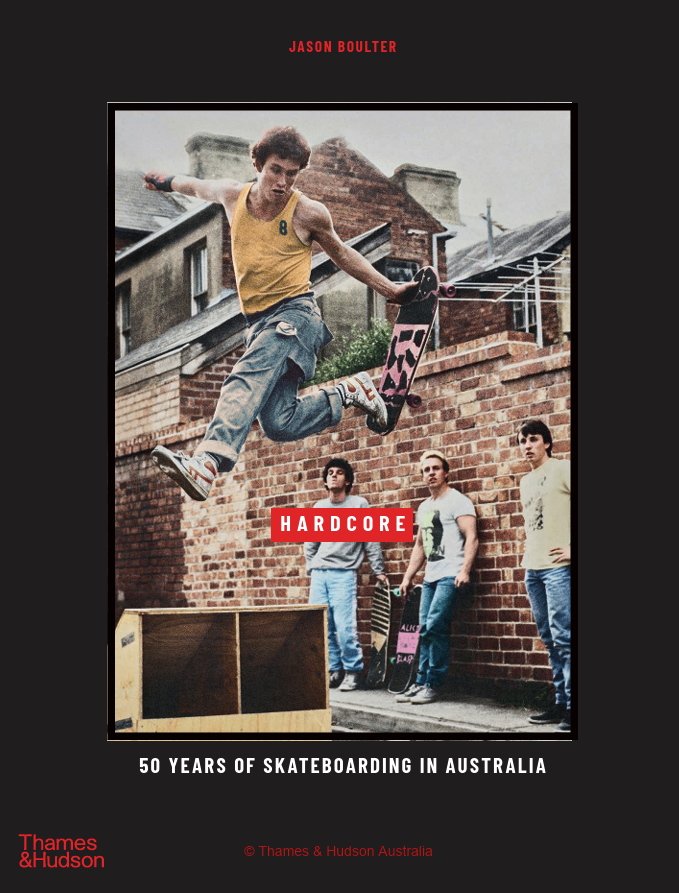
And on Thursday, 12 November 2026, it gets a celebration at Melbourne’s National Gallery of Victoria, where Globe will mark the release of HARDCORE.
There’s something satisfying about the setting. After the car parks, warehouse ramps, shopping-centre demos, Festival Hall and Rod Laver Arena, this chapter arrives at the NGV: fifty years of accumulated images and stories being celebrated inside one of the country’s major cultural institutions.
The progression would be difficult to improve on. Kids who once watched somebody else’s board being gripped helped create a history big enough to fill this book.
Now there’s a reason to get everyone together again.
Hopefully somebody else is handling the cash.
HARDCORE: 50 Years of Skateboarding in Australia is written by Jason Boulter, with photo editing by Bruce Fairlie, design by Hallie Lloyd and text editing by Judith Bamber. Published by Thames & Hudson Australia, the hardback is available now, RRP A$90.
Globe’s book-launch celebration takes place at the National Gallery of Victoria, Melbourne, on Thursday, 12 November 2026.
Words and interview by Toni Veziris.
Images supplied by Electric Collective for Globe.