
Artist Spotlight: James Cook (UK).
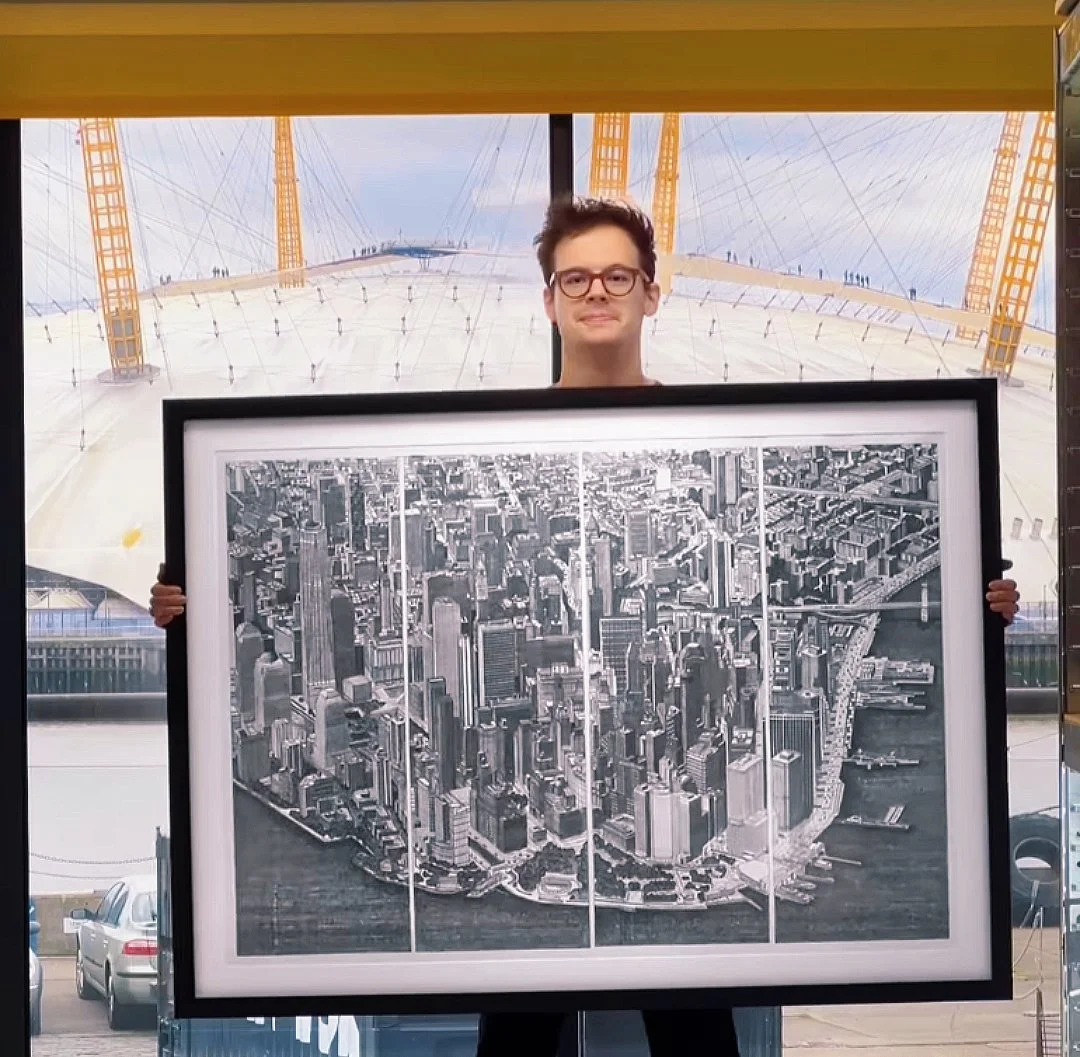
James Cook, Typewriter Artist - Via InstagramJames Cook is using his typewriters to create works of art that beg belief. A practice he’s redefined in the contemporary art world and digital landscape, what started as a discerning interest evolved into a style and voice of international acclaim.
Creating since 2014, he and his typewriter broke the internet. A dynamic pair, they’re instantly recognisable to any lovers of contemporary art and casual web surfers alike; James has veritably challenged traditional understandings of what it is to be a practising artist in the 21st century.
When not in his London studio, James globetrots with his typewriter. He freezes artefacts, national landmarks and entire cities within hundreds of thousands of single keystrokes, ‘naturally falling into rhythm with it’, a one-of-a-kind typist troubadour.
James very thoughtfully shared with me what it took to bring his vision to life, the hidden messages he leaves in his works for the sharp observers, and the places his work has taken him, places where no one could expect a typewriter to be found.
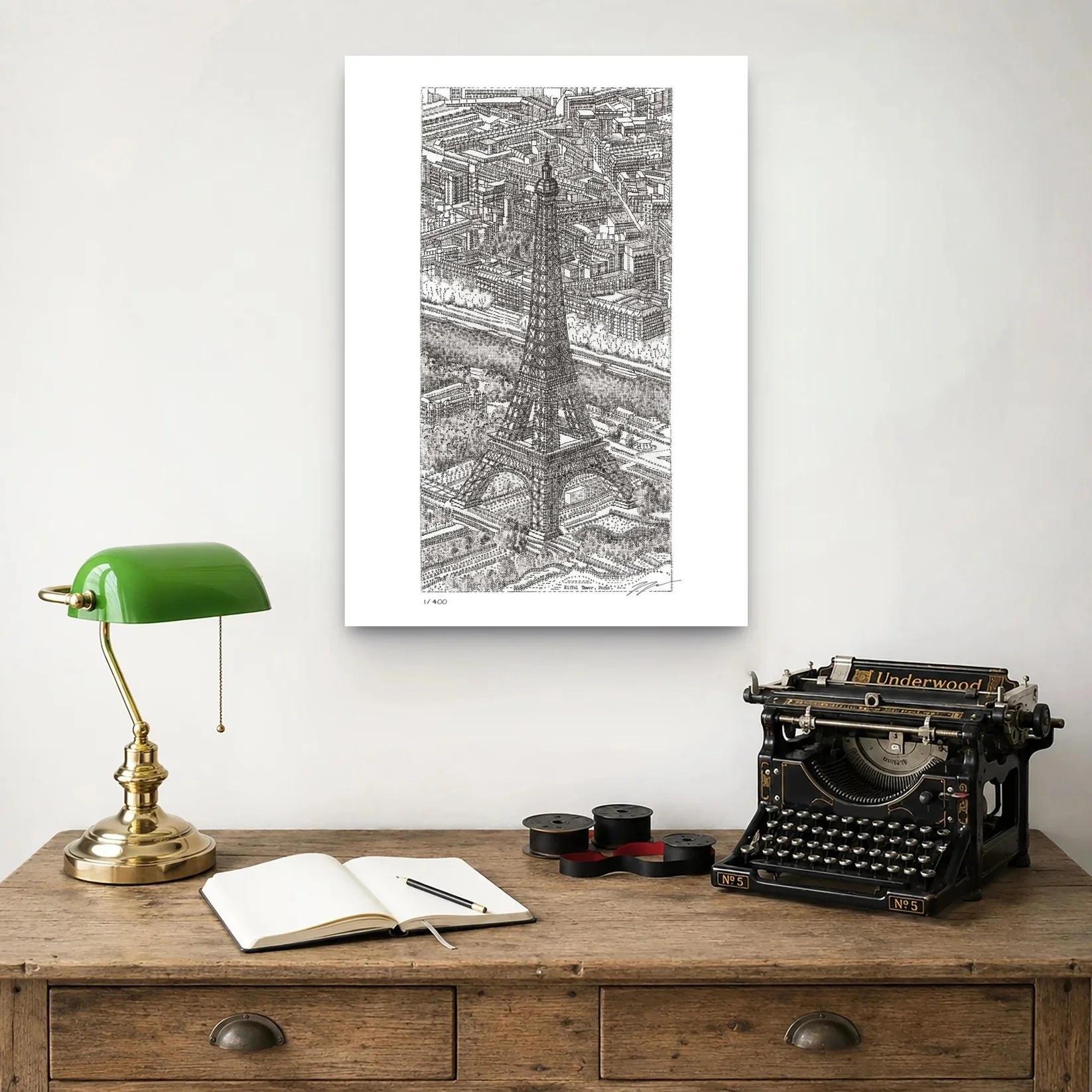
‘Eiffel Tower’ 2023Joseph Agius: You’ve said that making art using a typewriter started as a school project. When was the moment you thought, “Wow, this is lightning in a bottle,” and knew you had to pursue it?
James Cook: Yes, it started as a school art project back in 2014. In fact, two years ago I celebrated a decade of creating typewriter art with an exhibition in London, which was quite surreal.
It’s amazing how quickly that time has passed. Over the last 12 years, I have created over 350 artworks.
The original school project was about artists throughout history who had used technology in their work, and how new technologies had influenced the way art was made. I was initially interested in David Hockney and his experiments with fax machines in the 1980s. I couldn’t get hold of a fax machine myself, but while researching alternatives, I stumbled across typewriter art, an art form with a history stretching back to the Victorian era.
That was when I discovered the work of Paul Smith, who is something of a pioneer within the history of typewriter art. His story completely fascinated me. Smith was born with cerebral palsy and, as a child, his parents gave him a typewriter because he struggled to hold a pen or pencil. They wanted to give him a way to read and write, but what emerged was this extraordinary artistic ability. He discovered that the mechanical action of pressing individual keys gave him a way to create incredibly detailed pictures that he otherwise couldn’t produce using conventional drawing tools.
Both his story and his artwork astounded me. I remember searching online to see who else was creating this kind of work and finding remarkably few contemporary artists doing it. It was such a niche and largely forgotten art form, and something about that really appealed to me. I felt there was an opportunity to take this old technology and see what I could do with it in a contemporary way.
But there wasn’t necessarily one moment when I thought, “This is it.” For a long time, typewriter art was simply something I was completely fascinated by and pursued alongside everything else. I went on to study architecture at the Bartlett School of Architecture at University College London, completing both my undergraduate and master’s degrees over five years, while continuing to make typewriter art in the background.
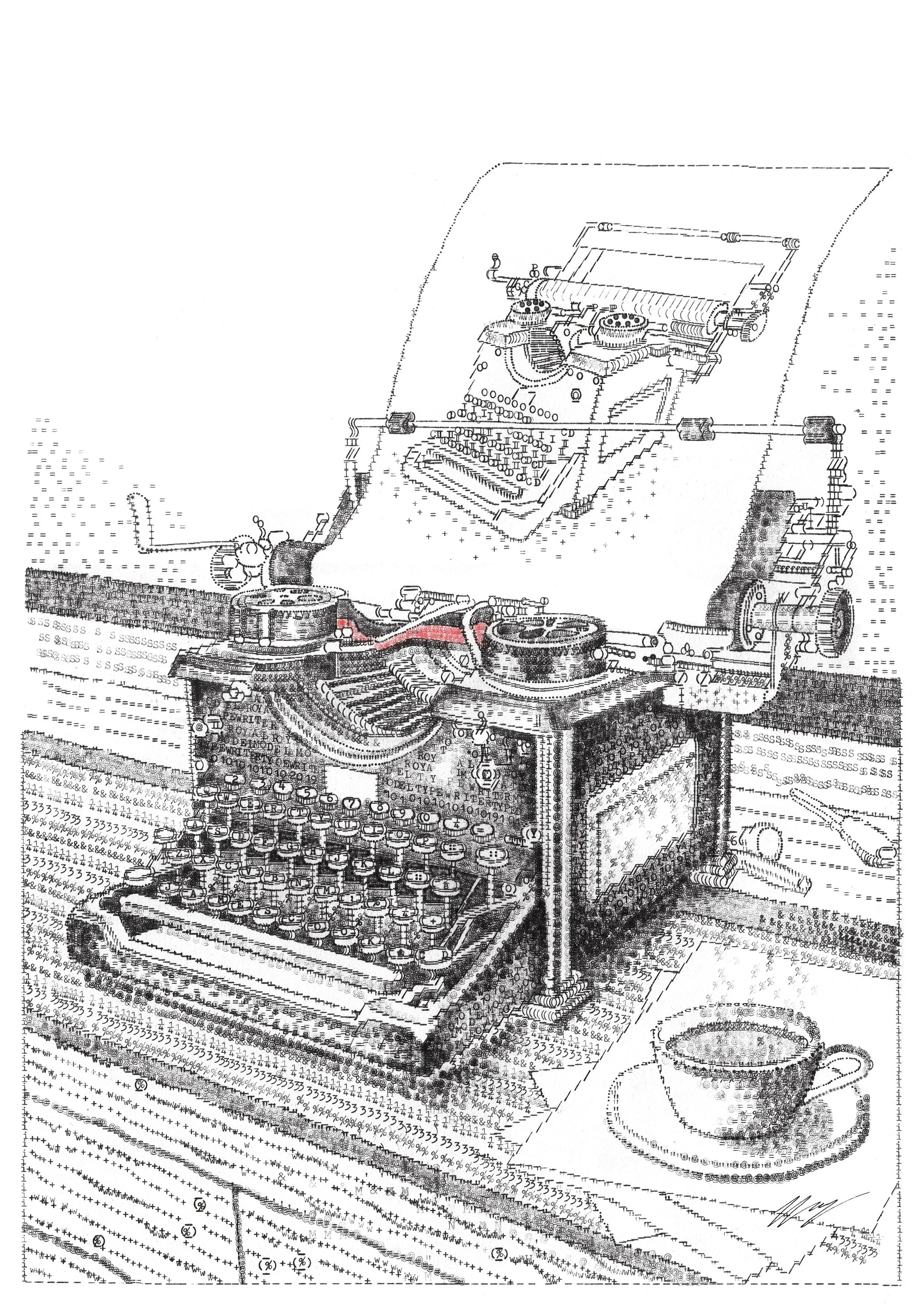
‘Typewriter Typing a Typewriter’, 2023Gradually, though, something started happening. I was building an audience online, and newspapers and television programmes began taking an interest in the work. I remember still being at university and occasionally having to sneak out of lectures to take phone calls from journalists wanting to interview me about my typewriter art. It began to feel as though this strange hobby I had started at school was becoming something much bigger.
The real turning point came when I graduated during the COVID period. Work opportunities were limited, I had built a growing audience on Instagram, and there was increasing media interest in what I was doing, including coverage from the BBC. Like a lot of people at that time, I found myself reassessing what I actually wanted to do with my life. I remember thinking that if there was ever a moment to take a leap of faith, this was probably it.
My immediate family were incredibly supportive, but beyond that there was definitely some scepticism. The idea that I was going to spend my career making pictures with typewriters sounded completely implausible to a lot of people. Becoming an artist is difficult enough; becoming a full-time typewriter artist probably sounded even more ridiculous.
But my gut instinct told me there was something there worth pursuing. So I followed it, and somehow that school project from 2014 became my career.
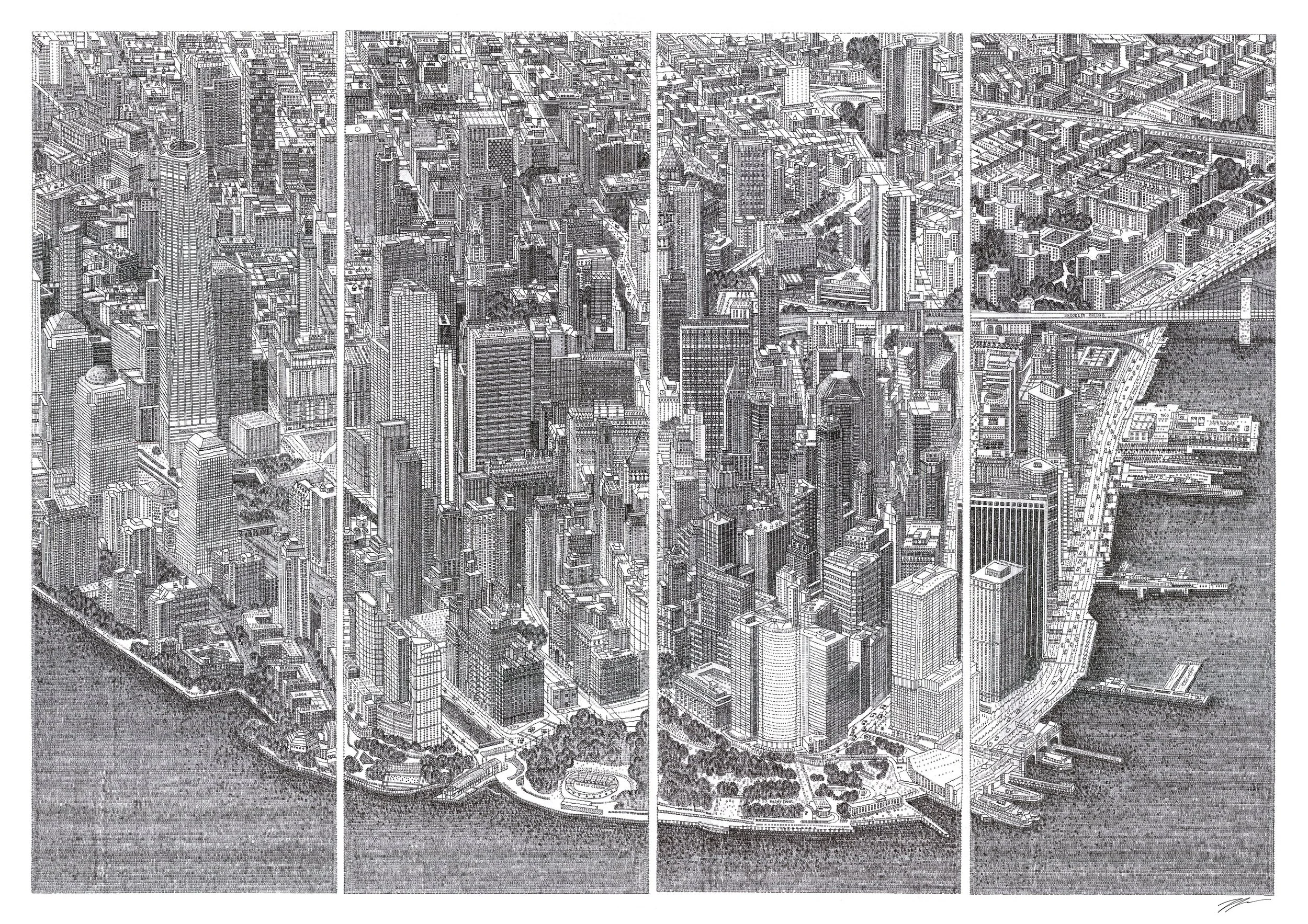
‘New York 400th Anniversary’. 118cm x 84cm. Contains over 1000,000 letters, numbers and punctuation marks.How do you pick your subjects? Do you have ‘type-vision’ where you visualise letters over striking views as you go about your day?
I have to be incredibly selective about the subjects I choose because of the amount of time each artwork takes to create. A single drawing can take me four to five weeks, and there really aren’t any shortcuts. Everything you see is typed individually, by hand, using a typewriter. Realistically, that means I can produce around 11 or 12 major artworks in an entire year, so essentially one drawing per month.
Because of that, every subject has to earn its place. I’m naturally drawn to subjects with a wider appeal, particularly places that I find architecturally interesting or have a personal connection with. New York is a great example. I’ve created the view from Top of the Rock looking across the Manhattan skyline, as well as Times Square. Closer to home in London, I’ve depicted landmarks including Big Ben, Tower Bridge, Battersea Power Station and the Royal Albert Hall.
I also love creating work that coincides with a particular cultural moment or major sporting event. Most recently, I created an artwork around Wimbledon, depicting the action on Centre Court. It actually began entirely as a passion project, but Wimbledon later invited me to the Championships, where I had the extraordinary experience of sitting with my typewriter on Centre Court and creating a film that became part of the build-up to the men’s final.
As for whether I have “type vision”, I think after doing this for more than a decade, I probably do! I’ve developed this mental catalogue of which letters, numbers and punctuation marks are useful for creating particular shapes, textures and tones. None of it is formally written down; it’s just something I’ve accumulated through years of working with the typewriter.
When I look at an image now, part of my brain is already beginning to break it down into those individual marks. I often describe creating typewriter art as solving an enormous puzzle. You have a very limited set of pieces available to you, the keys on the keyboard, and the challenge is working out how to piece those characters together to create something that, when you step back from it, becomes an image.
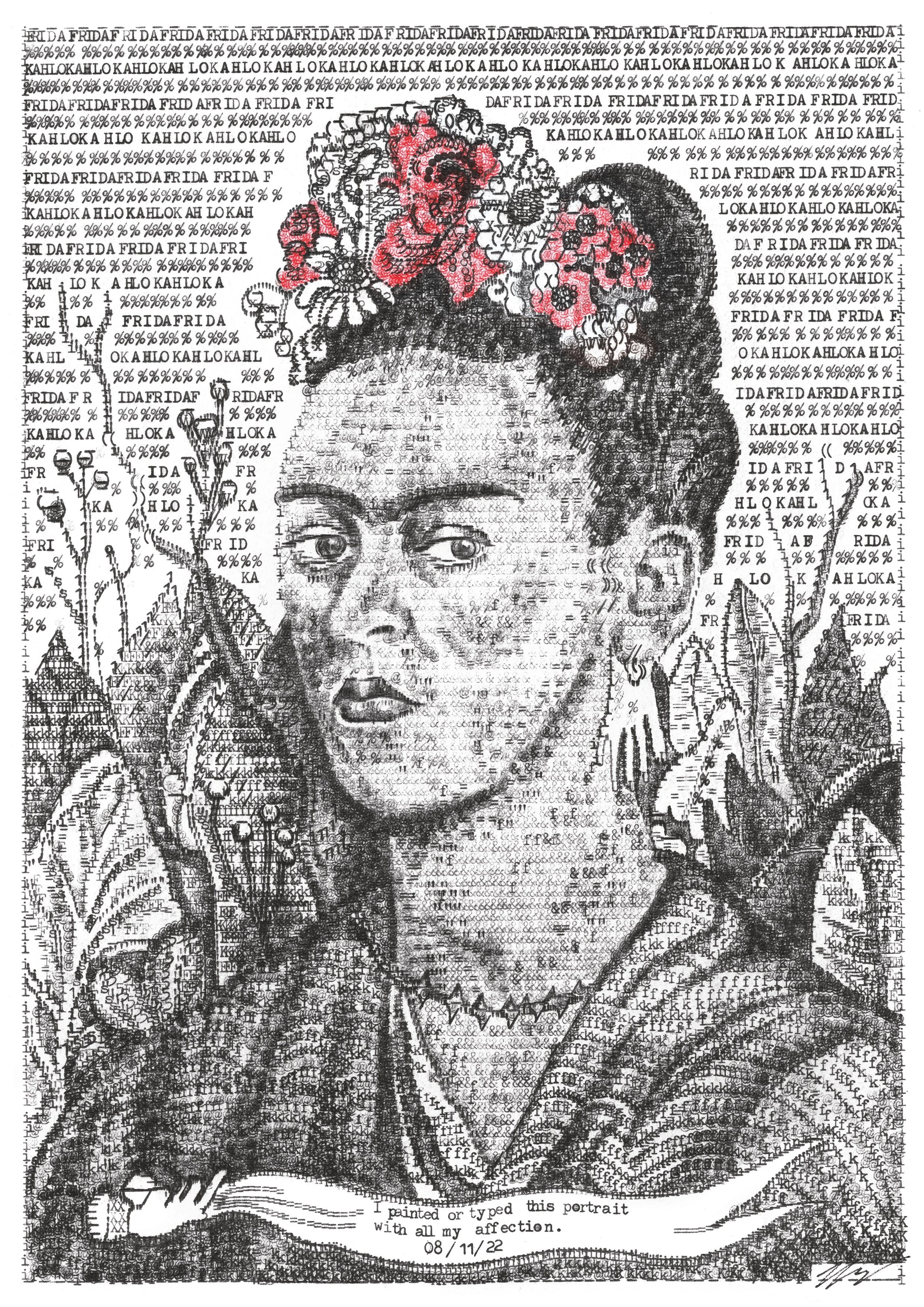
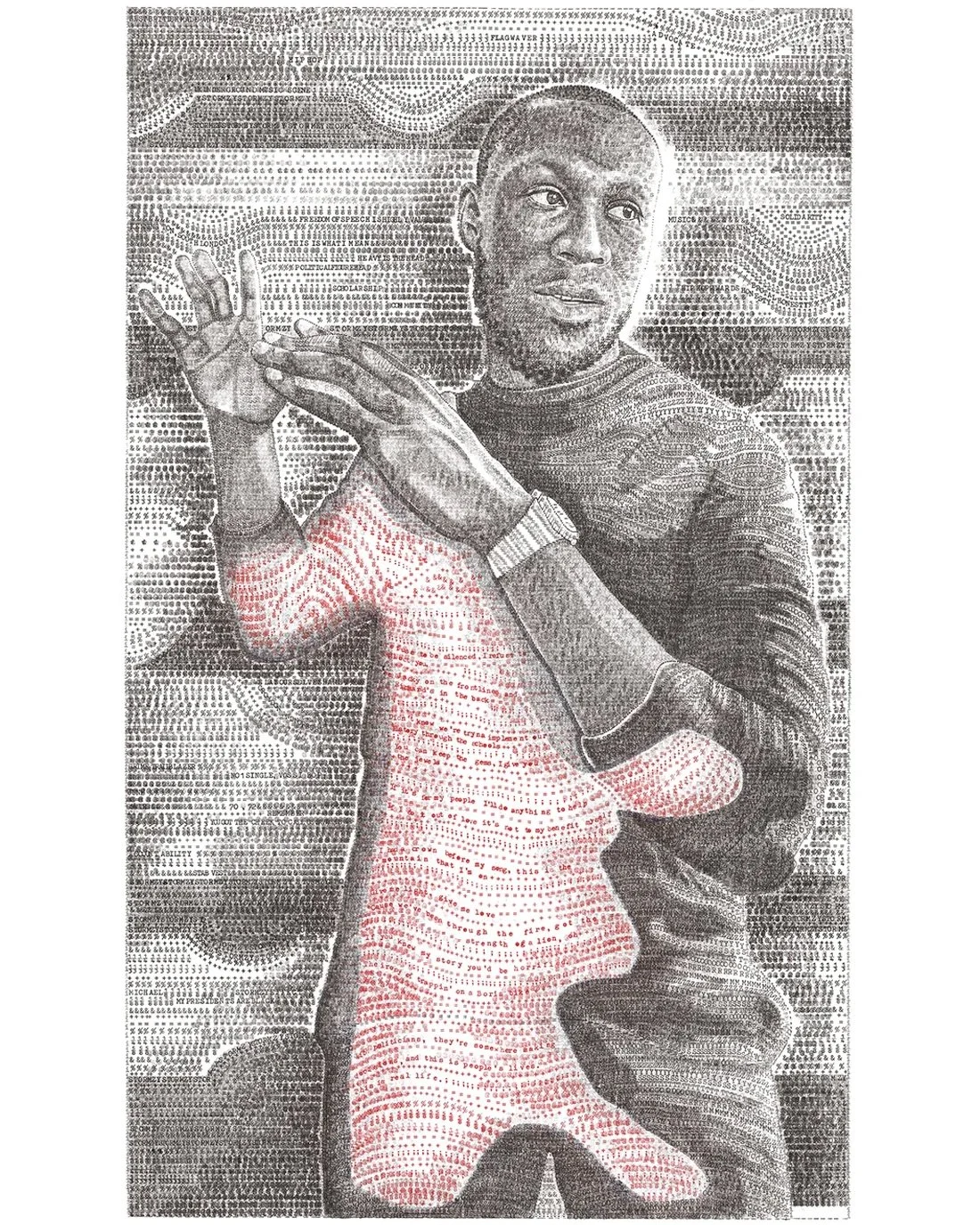
Close-ups of typed portraits: Frida Kahlo; Stormzy.Using a typewriter to press art onto paper is almost totally mechanical (bar using electric typewriters like a ‘91 Royal Scriptor). Would the process/end result mean the same to you if they were typed with a laptop and printed?
In some ways, making art on a laptop, like ASCII art, could be considered a digital relative of typewriter art. It uses the same basic vocabulary of letters, numbers and punctuation marks to construct an image, but for me, the physical process of using a typewriter is fundamental to why I make the work.
I’m a very tactile person, and there’s something incredibly satisfying about the mechanical nature of a typewriter: the weight of the keys, the resistance when you press them, and the physical act of striking an image onto paper. In some ways, the keyboard reminds me of the keys of a piano, which perhaps explains why I’m so drawn to it.
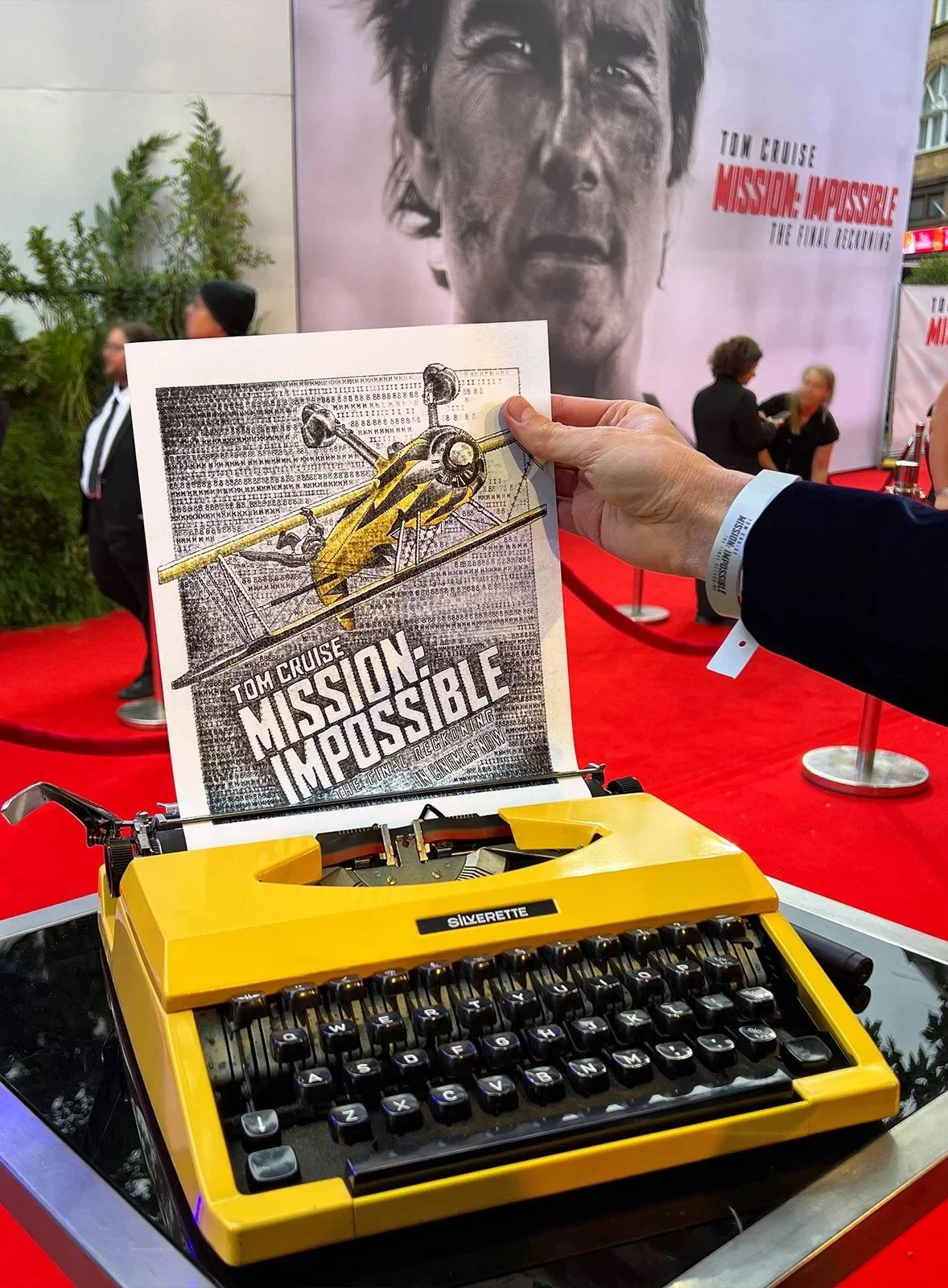
Movie poster of Mission: Impossible – The Final Reckoning, at the red carpet premier, 2025Alongside art, music has always been a big part of my life, and I’ve played the piano since I was a child. Growing up, art and music always felt like two completely separate interests, whereas typewriter art has unexpectedly brought those two worlds together.
People often comment on the sound when they watch videos of me working. A typewriter has its own rhythm: the striking of the keys, the movement of the carriage, the bell at the end of a line. When I’m working, I naturally fall into a rhythm with it, almost without thinking. There’s something quite musical about the whole process, and when you’re spending four or five weeks on a single drawing, that rhythm becomes part of the experience of making it.
So while I could technically create an image from letters and symbols on a laptop and print it out, it wouldn’t mean the same thing to me. It would remove the physicality, the sound, the rhythm and, importantly, the evidence of the human hand behind the work. With a typewriter, every mark on the page represents an individual physical action. The process isn’t simply a means of arriving at the finished image; the process is a huge part of what gives the work its meaning.
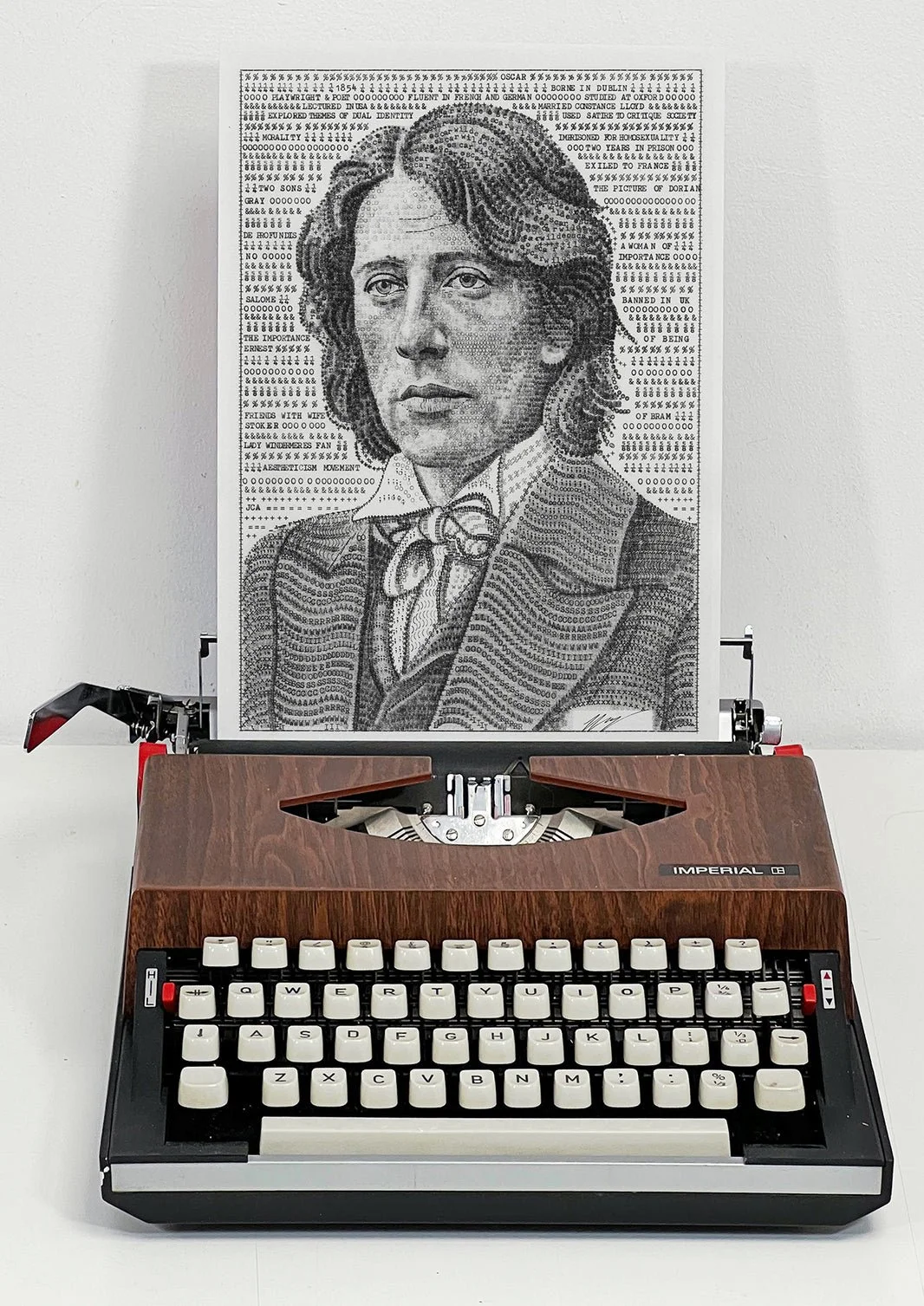
Portrait of Oscar Wilde typed on a vintage Imperial Fleetwood 260Your practice works on multiple aesthetic levels: art made with typewriters that are beautiful in their own right. A typewriter’s presence can invite themes of refinement and austerity. What does typewriting lend to your vision?
I’ve always found something fascinating about taking an object with such a clearly defined purpose and asking it to do something it was never intended to do.
When you draw with a pencil, you have an enormous amount of freedom. You can create almost any line, shape or tone you want. With a typewriter, my entire visual language is predetermined by what exists on the keyboard. I have a finite collection of letters, numbers and punctuation marks, and somehow I have to use those same characters to describe everything from the glass façade of a building to a human face or the atmosphere of a crowd at Wimbledon. That limitation forces you to become incredibly inventive.
Perhaps my architectural background comes into it as well. There’s something very structured about the way I work. Every image is constructed gradually from hundreds of thousands of individual marks, almost like assembling a building from its component parts.
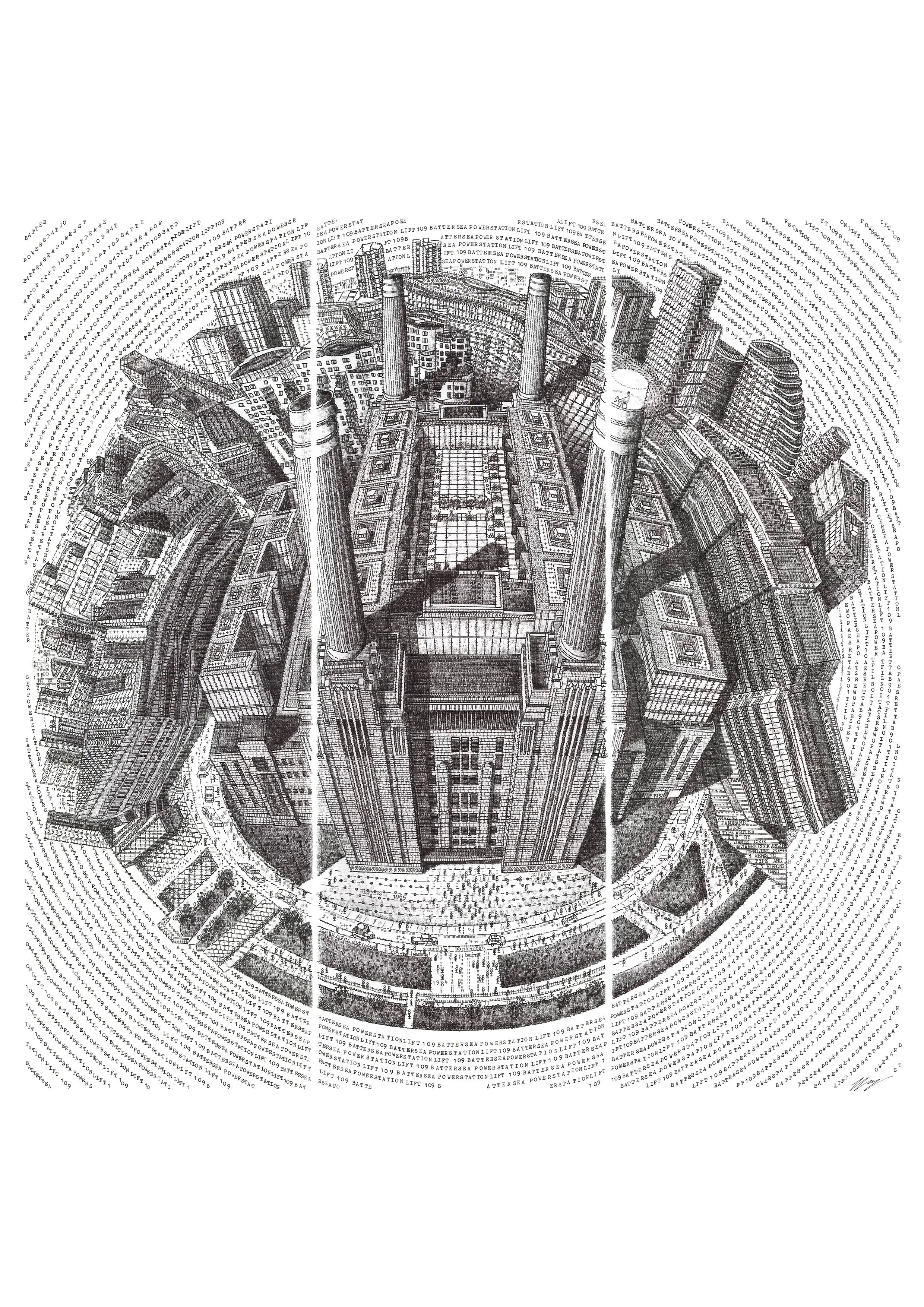
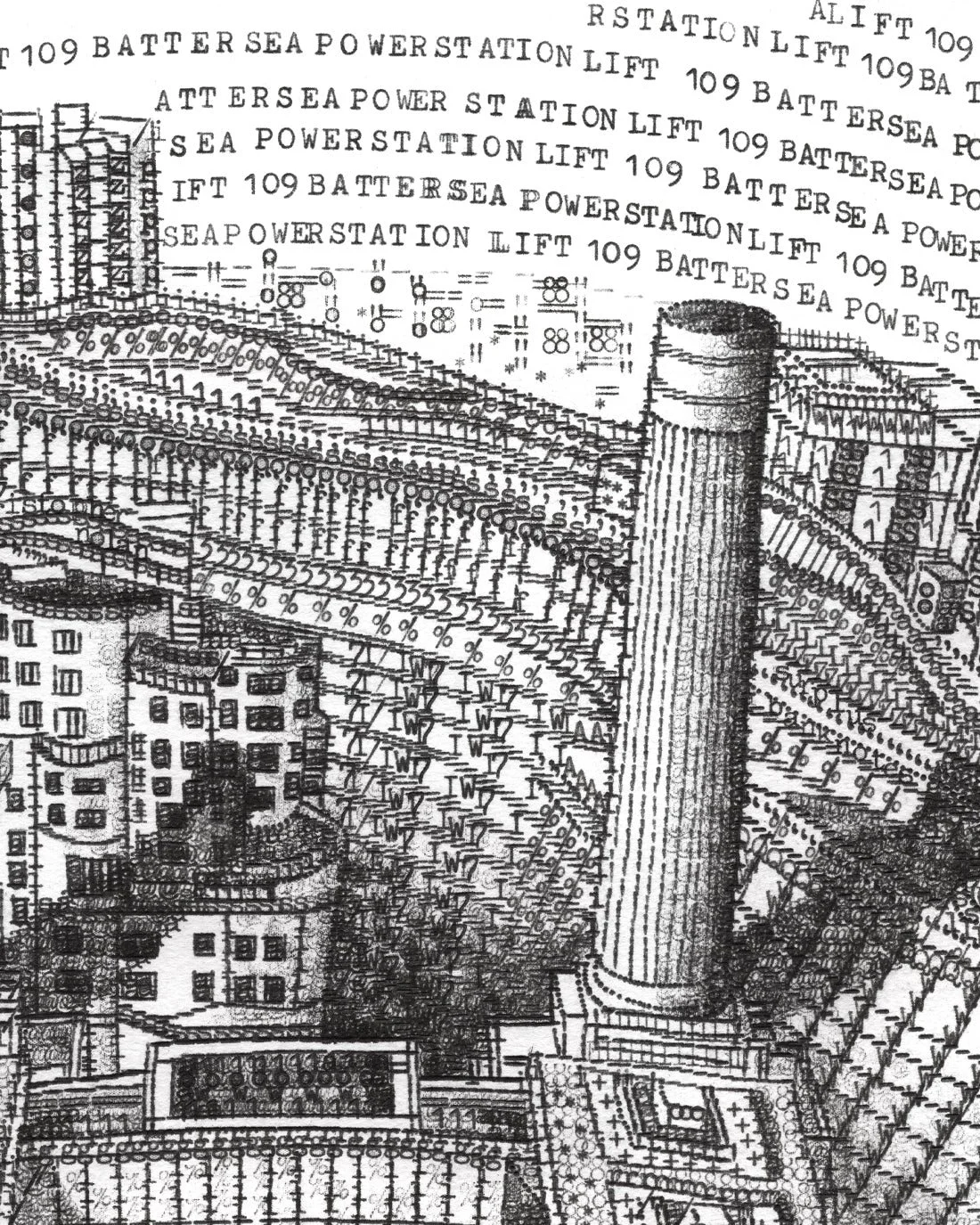
Chimney-Top Typing: In Collaboration with Battersea Power StationHow many words can you type per-minute?
78wpm – I did the online test! (Not that impressive … right?) haha.
With typewriter art, it’s not words I am necessarily typing. It’s mostly a hodgepodge of random text. What I can say is that within the space of 4-5 weeks, I can create a drawing made from over 800,000 letters, numbers and punctuation marks. I had a computer plugin which counted the noise of every keystroke of my typewriter, and this is roughly what it counted from one of my A3-size artworks.
How often do you find yourself tinkering with the components? Is modifying them part of the process?
Interestingly, I very rarely tinker with the typewriters themselves. They’re incredibly durable, robust machines and, in my experience, they require remarkably little intervention.
The typewriter I use most regularly is a 1963 Olympia SG-3 with a wide carriage, which sits on my desk and is effectively my everyday working machine. It’s built like a tank. Typewriters from that period were constructed predominantly from cast metal, with very little plastic, so there simply aren’t many components that bend, crack or break in the way we’ve become accustomed to with more modern products.
I actually quite like the fact that modifying the machine isn’t part of my process. I’m essentially using the typewriter as it was originally designed and built more than 60 years ago; the experimentation comes from what I can persuade it to do on the page.
On the rare occasion that something does need repairing or restoring, there’s a wonderful couple here in the UK known as Mr and Mrs Vintage Typewriters, who have also appeared as typewriter restorers on the BBC’s The Repair Shop. I occasionally go to them if one of my machines needs attention, and I’ve also bought typewriters from them over the years.
But generally, they just keep going. There’s something quite remarkable about using a piece of technology built in 1963 as a professional tool every day and finding that, more than six decades later, it still does exactly what it was designed to do.
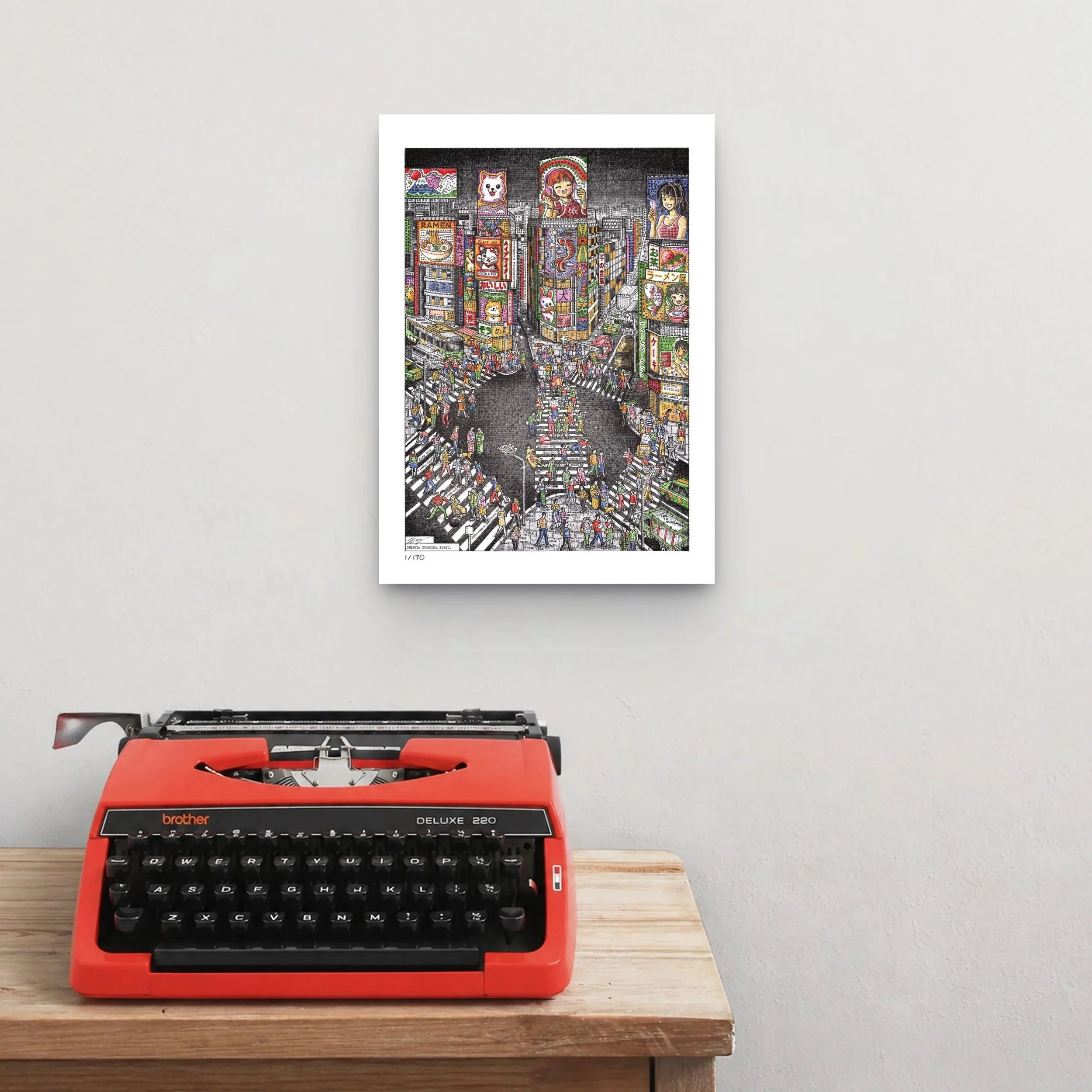
James Cook’s ‘Evening in Tokyo’, with Japanese typewriter Brother Deluxe 220In a funny way, everyone, regardless of language, can read the pages you type. What messages are you trying to send to your audience?
Quite literally, there are messages in my work. I love concealing words, names and little pieces of information within the drawings. From a distance, an artwork might appear to be a conventional image, albeit one packed with an enormous amount of detail, but as you move closer, you begin to realise that the entire thing is constructed from type. Then, if you look closer still, you start discovering these hidden messages.
Often they’re historical facts connected to the subject I’m depicting, or significant names, dates and words that relate to that particular place. In my recent Wimbledon piece, for example, I incorporated the names of iconic players associated with the Championships, alongside references to the history and traditions of Wimbledon itself. I like the idea that somebody can spend time with an artwork and continue discovering things that perhaps weren’t apparent on first viewing.
There’s often some humour hidden in there too. I’ll occasionally type in something slightly satirical, or introduce tiny characters caught in strange situations: somebody tripping over, something going wrong, little moments of chaos unfolding within an otherwise meticulously constructed scene. They’re details that might only occupy a tiny part of a very large drawing, but they give the work personality.
I suppose that’s what I want the audience to take from it: curiosity. The image can be understood immediately, regardless of the language you speak, but there are multiple levels on which you can read it.
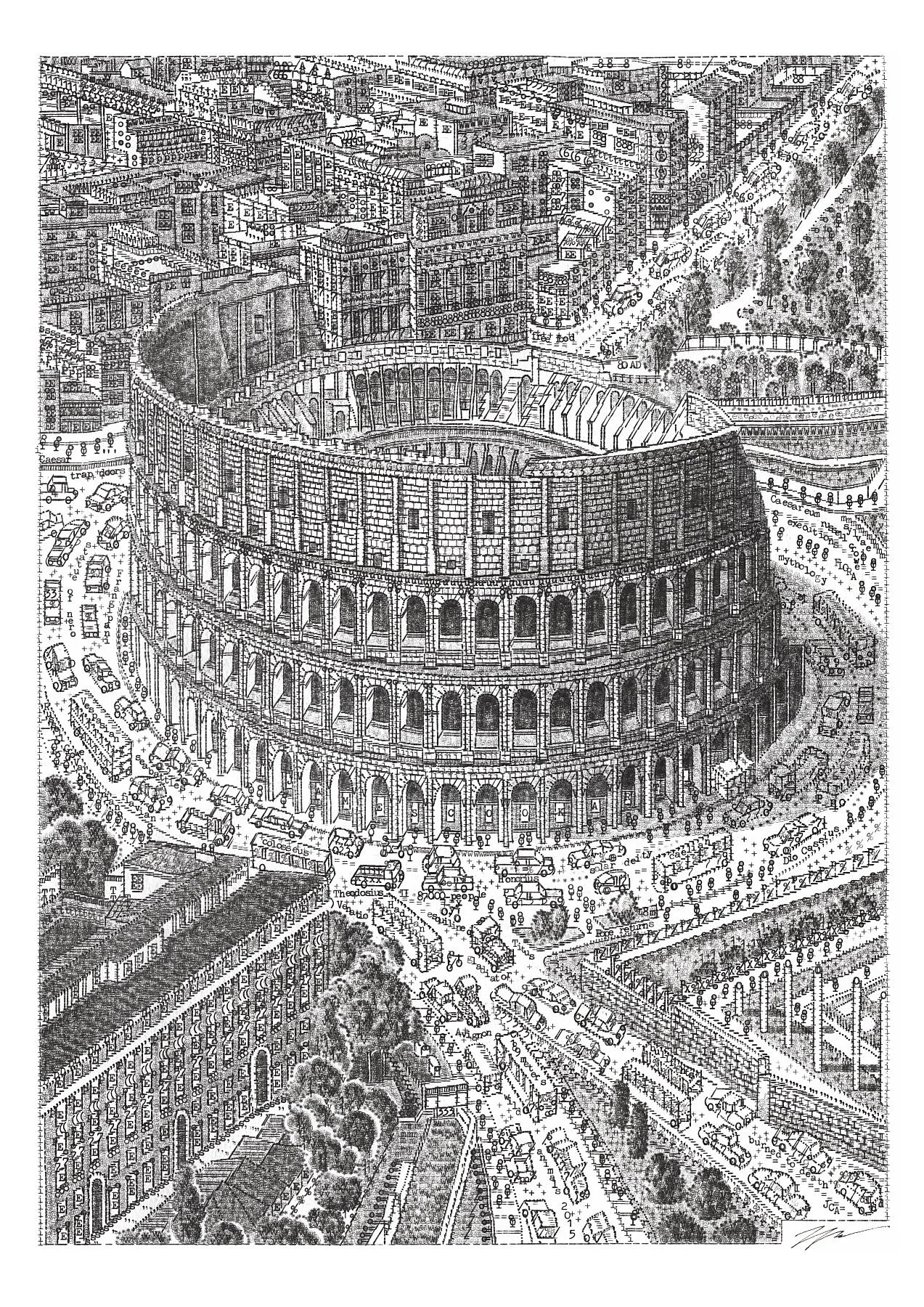
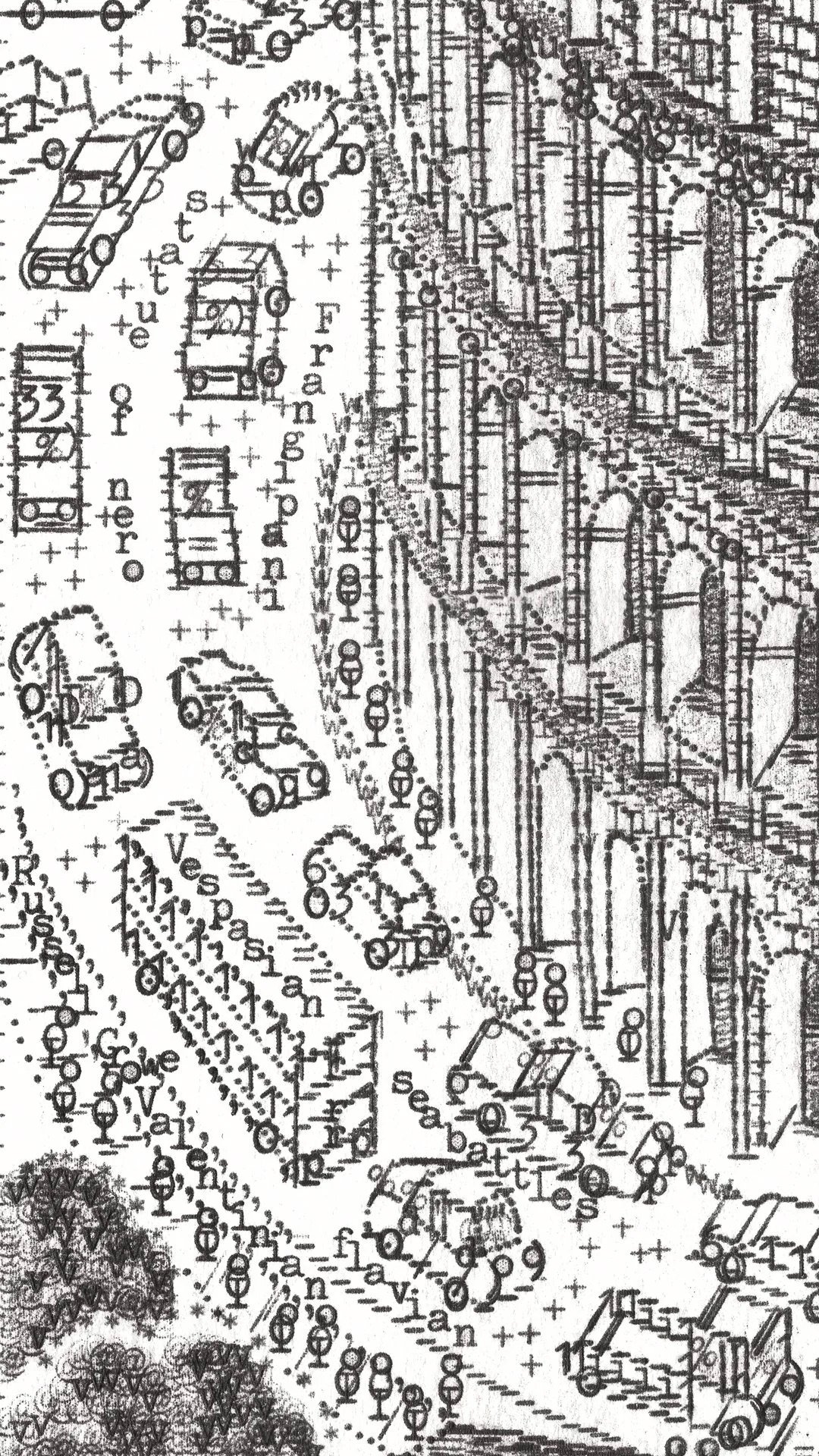
Names in the Colosseum’s streets – ‘Vespasian,’ ‘Statue of Nero’, and ‘Russell Crowe’.Your practice has taken you across the world. What are your most memorable experiences having a typewriter in front of you?
Oh my word, there have been so many pinch-me moments where I’ve found myself thinking, “How on earth did this happen?” I’m incredibly grateful to the people and organisations who have invited me into places I never imagined I’d experience in this way.
Typing on the stage of the Royal Albert Hall was particularly special. It’s one of my favourite buildings in London and, as someone who loves music and the BBC Proms, sitting on that stage with a typewriter in front of me was completely surreal.
More recently, I had the opportunity to take my typewriter onto Centre Court at Wimbledon. We were there at night, with the stadium almost empty apart from members of the Wimbledon team, and I can still remember the sound of the keys ricocheting around Centre Court. Usually the sound of a typewriter is relatively intimate, so hearing every keystroke echo around one of the most famous sporting arenas in the world was extraordinary.
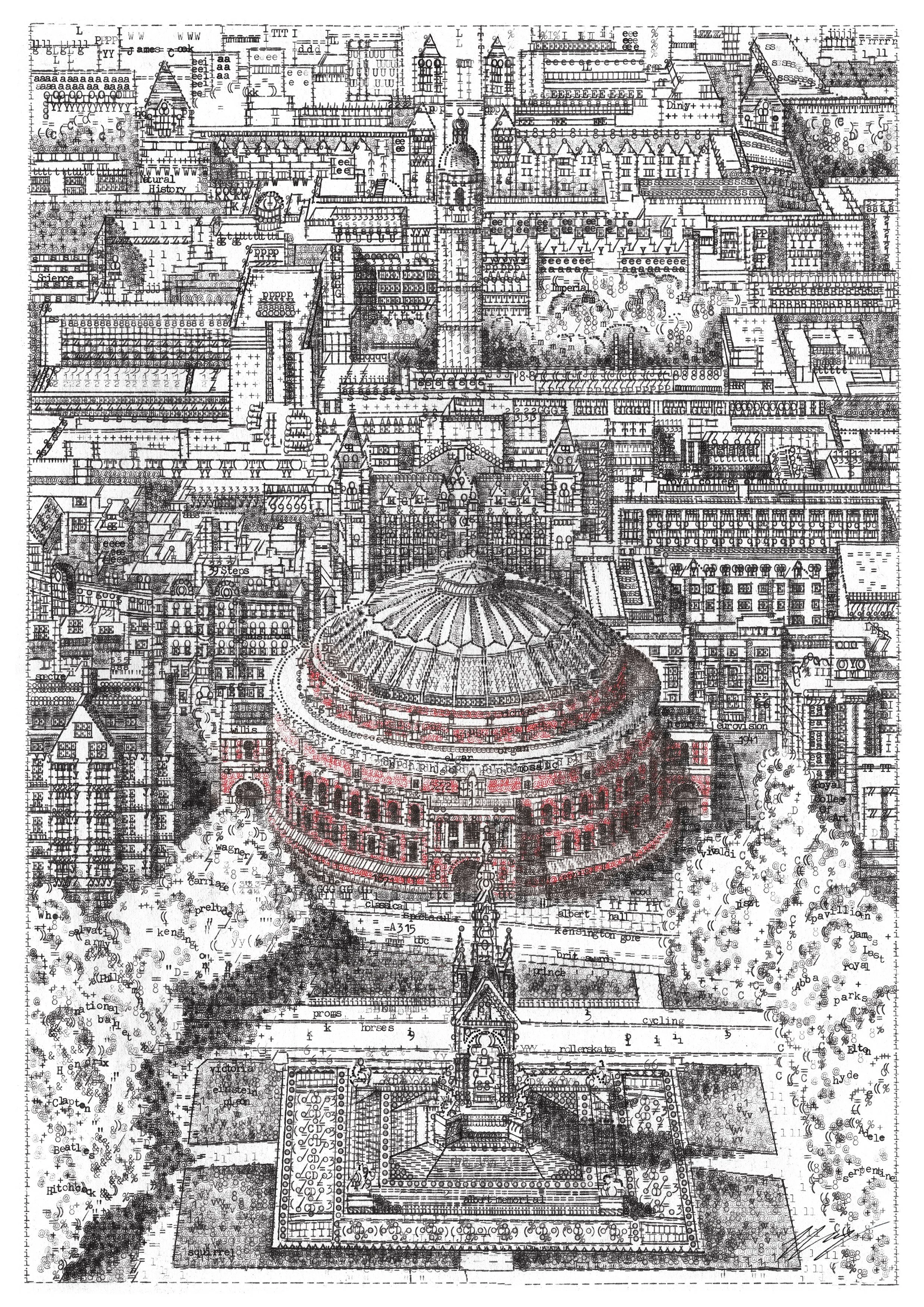
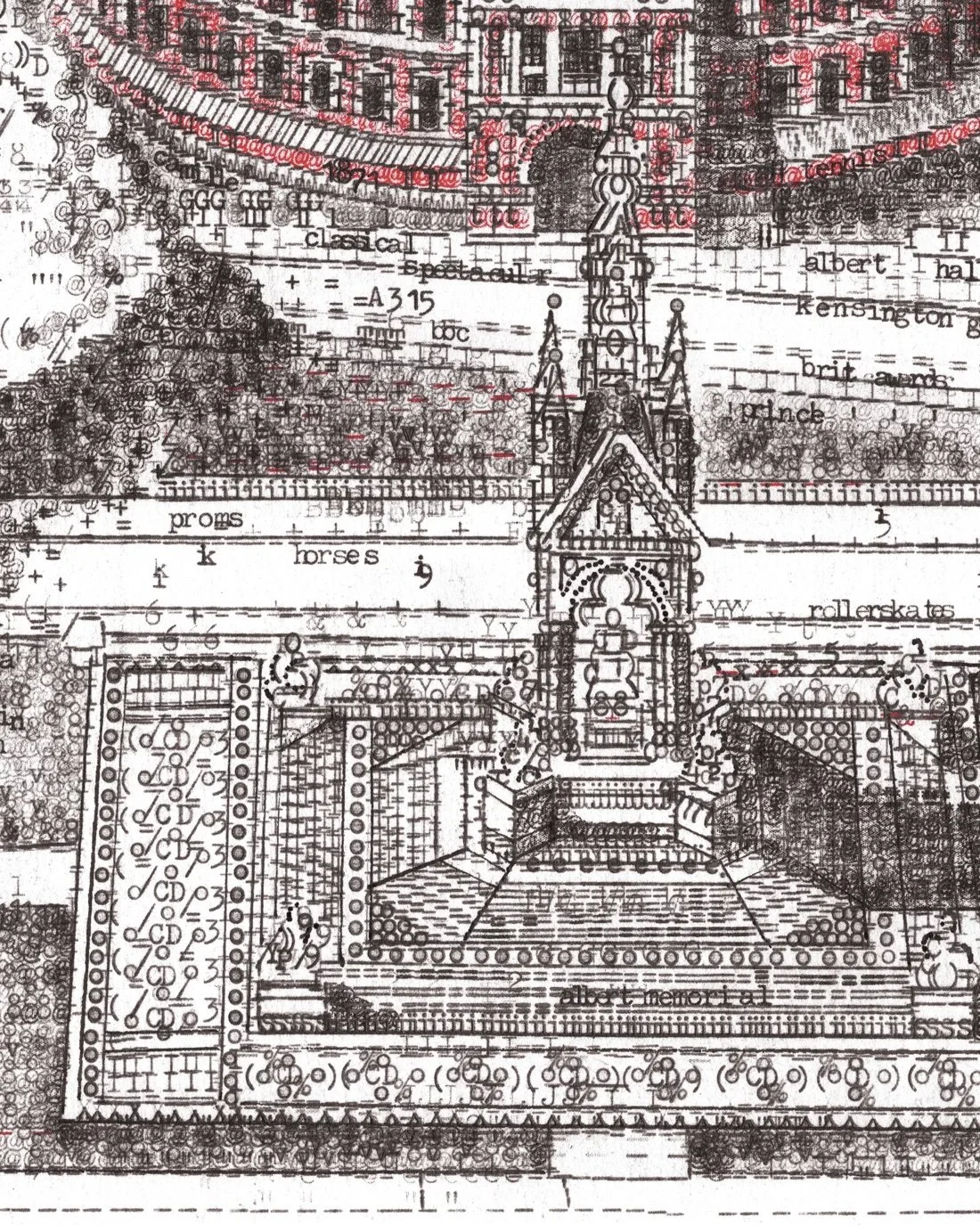
Cook’s 2023 artwork of London’s Royal Albert Hall.Then there was taking a typewriter to the top of the Rockefeller Center and working while looking out across the New York skyline. These are places I dreamed about visiting as a kid, so the idea that this slightly unusual art form I discovered through a school project would one day take me there still seems faintly impossible.
Of course, travelling around the world with typewriters has also produced some less glamorous memories! I once flew to Las Vegas for a project at CES with a typewriter packed inside a suitcase. From my window seat, I watched the luggage being unloaded and spotted my bright red suitcase coming off the aircraft practically bandaged together with tape. I immediately knew that wasn’t a good sign. When I opened it, the typewriter inside was in pieces. Thankfully, I had brought a backup typewriter with me, so the project survived. I’ve learned quite a few lessons about travelling with typewriters over the past decade.
One of the strangest things is that, ordinarily, I can walk around with complete anonymity. But put a typewriter in my hands and suddenly people recognise me. If I’m working outside, I’ll regularly have people stop and say, “You’re the typewriter art guy, I’ve seen you on Instagram or TikTok.” I find that incredibly surreal. Somehow the typewriter has become my passport; it has taken me around the world, opened doors to extraordinary places and created conversations with people I would otherwise never have met.
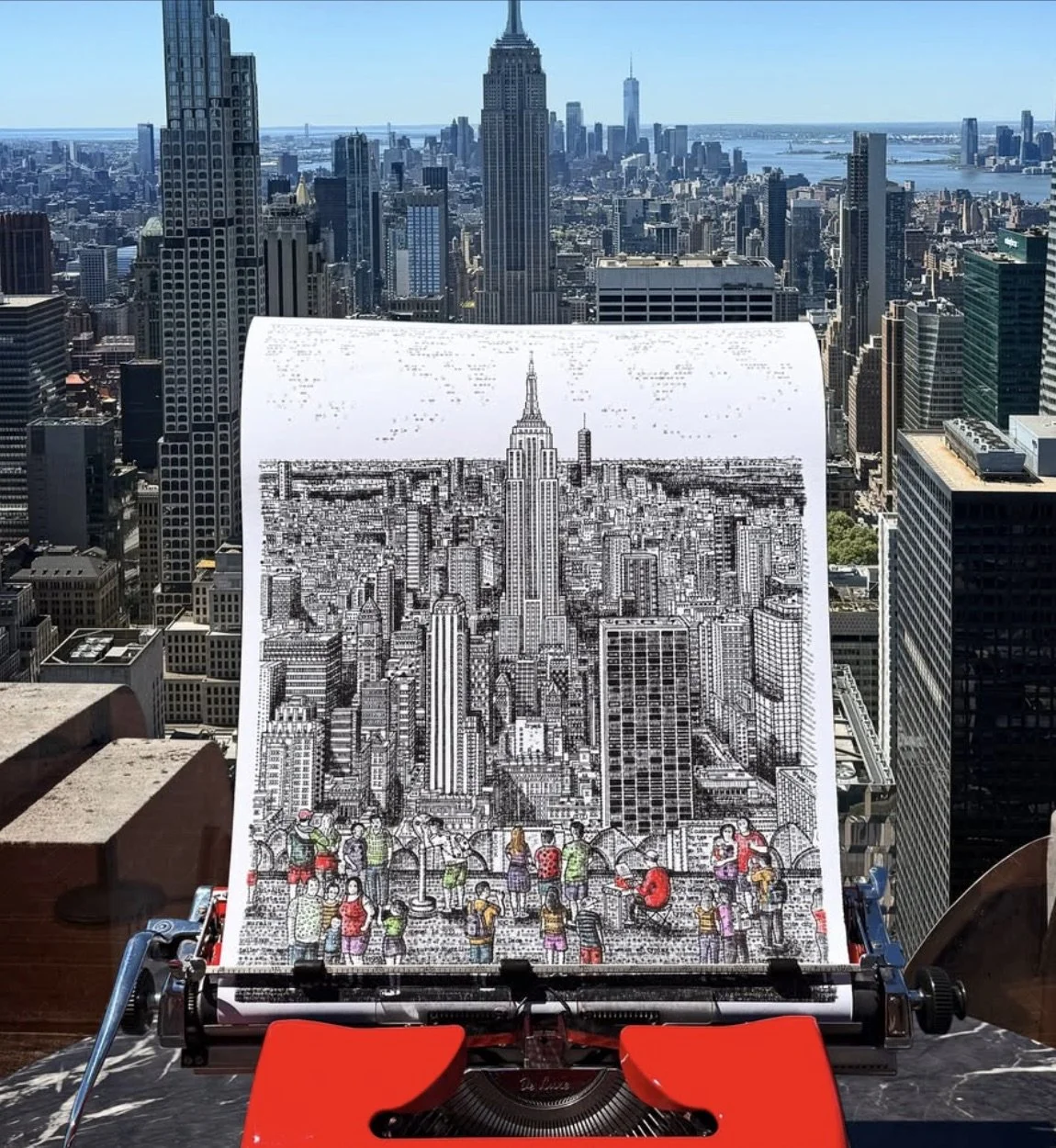
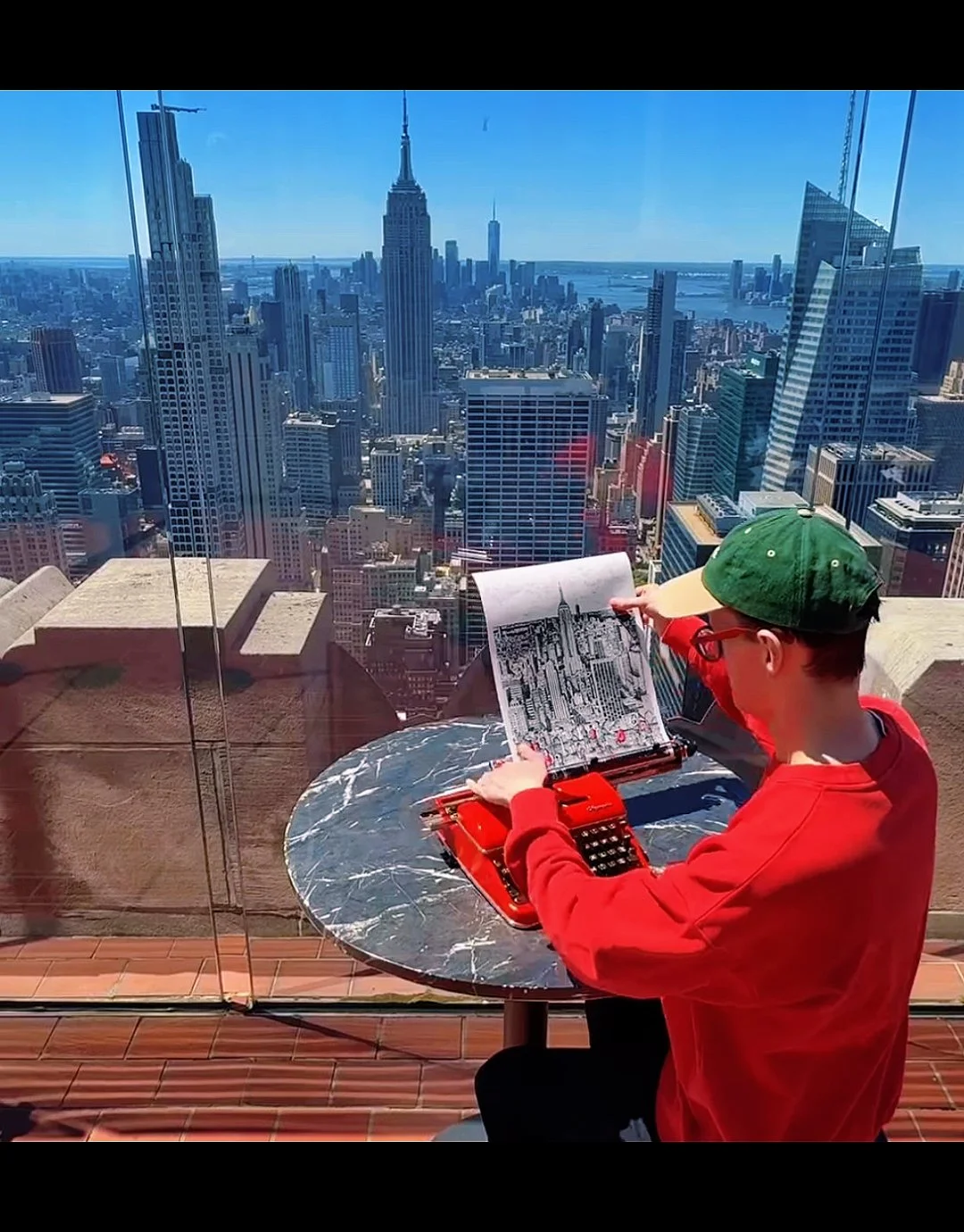
James typing on the top of the Rockefeller Centre, New York City.What challenges you with every new artwork? Which of your projects has meant the most to you?
The challenge is also knowing that I’m committing four or five weeks to a single image, entirely by hand, so there’s an enormous amount of patience involved and very little room for shortcuts. It’s difficult to choose one project that has meant the most to me because each tends to represent a particular moment in my journey, but the pieces that resonate most are those where the subject has a personal connection or where the artwork unexpectedly leads to an experience I could never have anticipated. Projects such as the Royal Albert Hall and Wimbledon began with my admiration for those places.
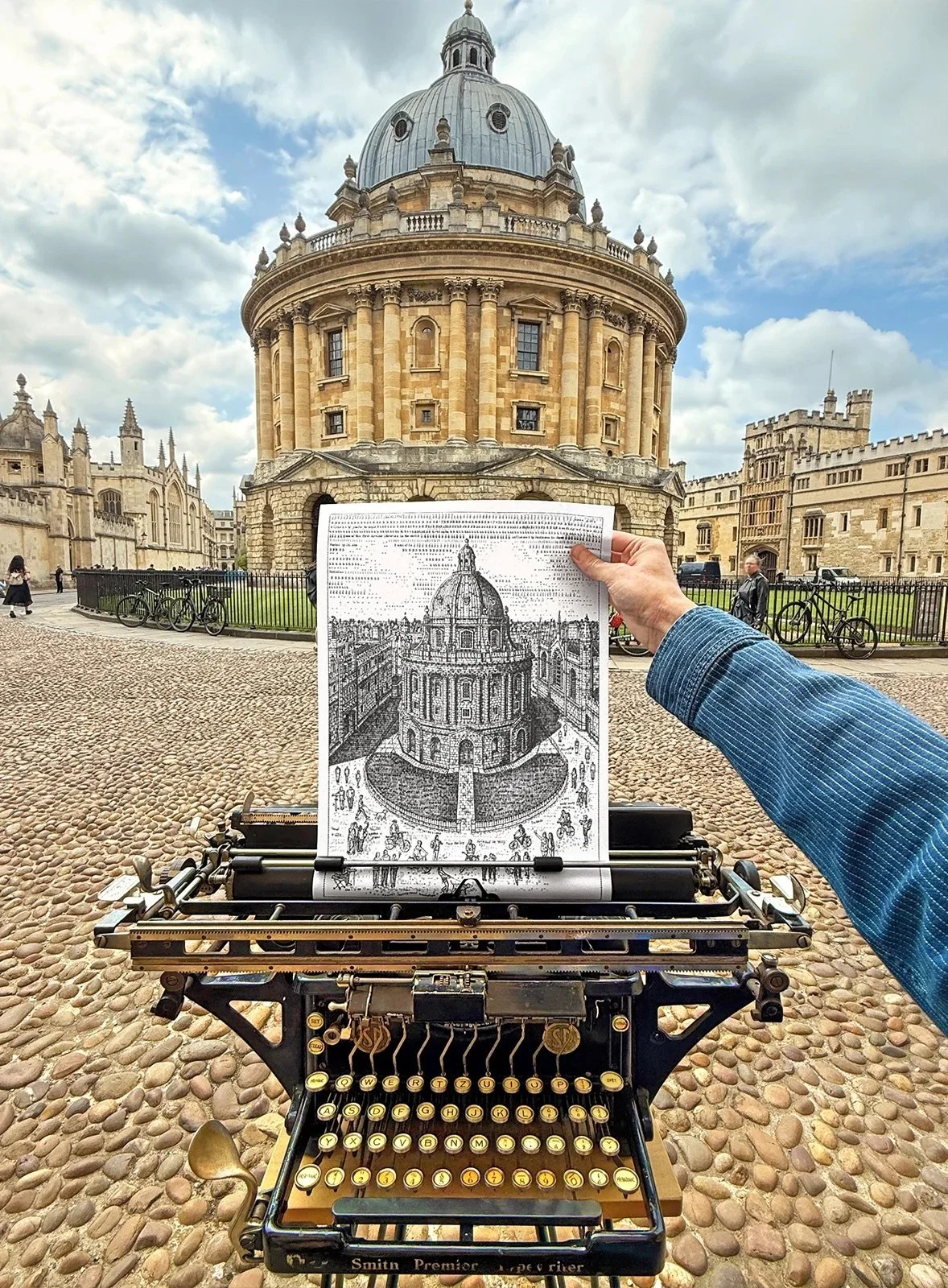
Radcliffe Camera at Oxford University, England.Are there any artists that have blown you away recently? What are your latest fixations?
One artist I’ve found myself returning to recently is Alex Brychta, whose illustrations I grew up with in the Biff, Chip and Kipper books. I’m not sure how familiar they are to readers in Australia, but in the UK those books seemed to be in virtually every primary school and children’s library, and his illustrations completely fascinated me as a child. Looking back, his work was one of the reasons I wanted to become an artist in the first place.
To my enormous surprise, Alex and I ended up connecting through Instagram years later, and he very kindly sent me a personalised illustration of me sitting at my typewriter. It’s now one of my most prized possessions. There’s something quite wonderful about growing up absorbed in somebody’s artwork, having it quietly shape your own desire to create, and then finding yourself in contact with that artist decades later. It’s a lovely reminder that the things we encounter as children can have a much greater influence on where we eventually end up than we realise at the time.
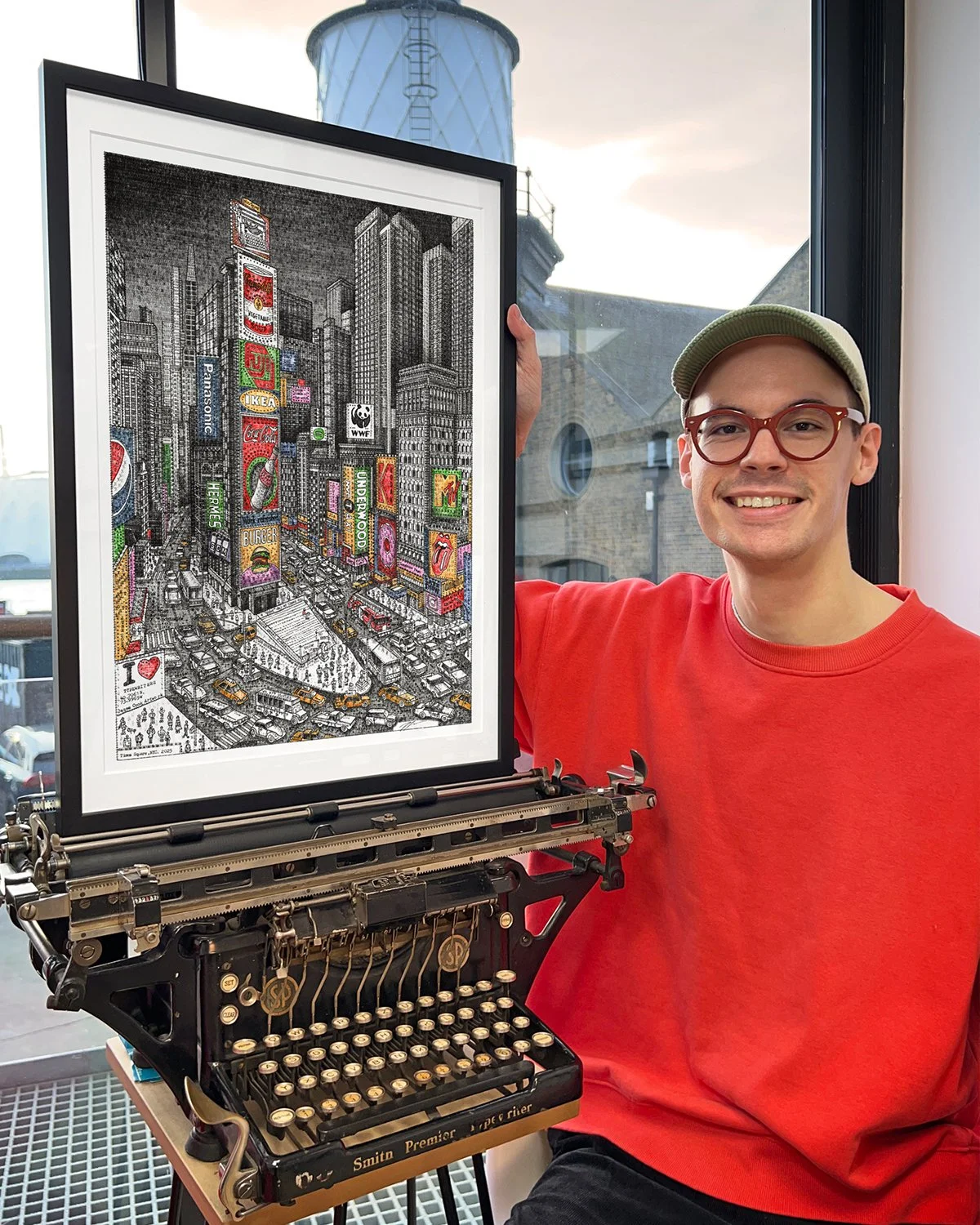
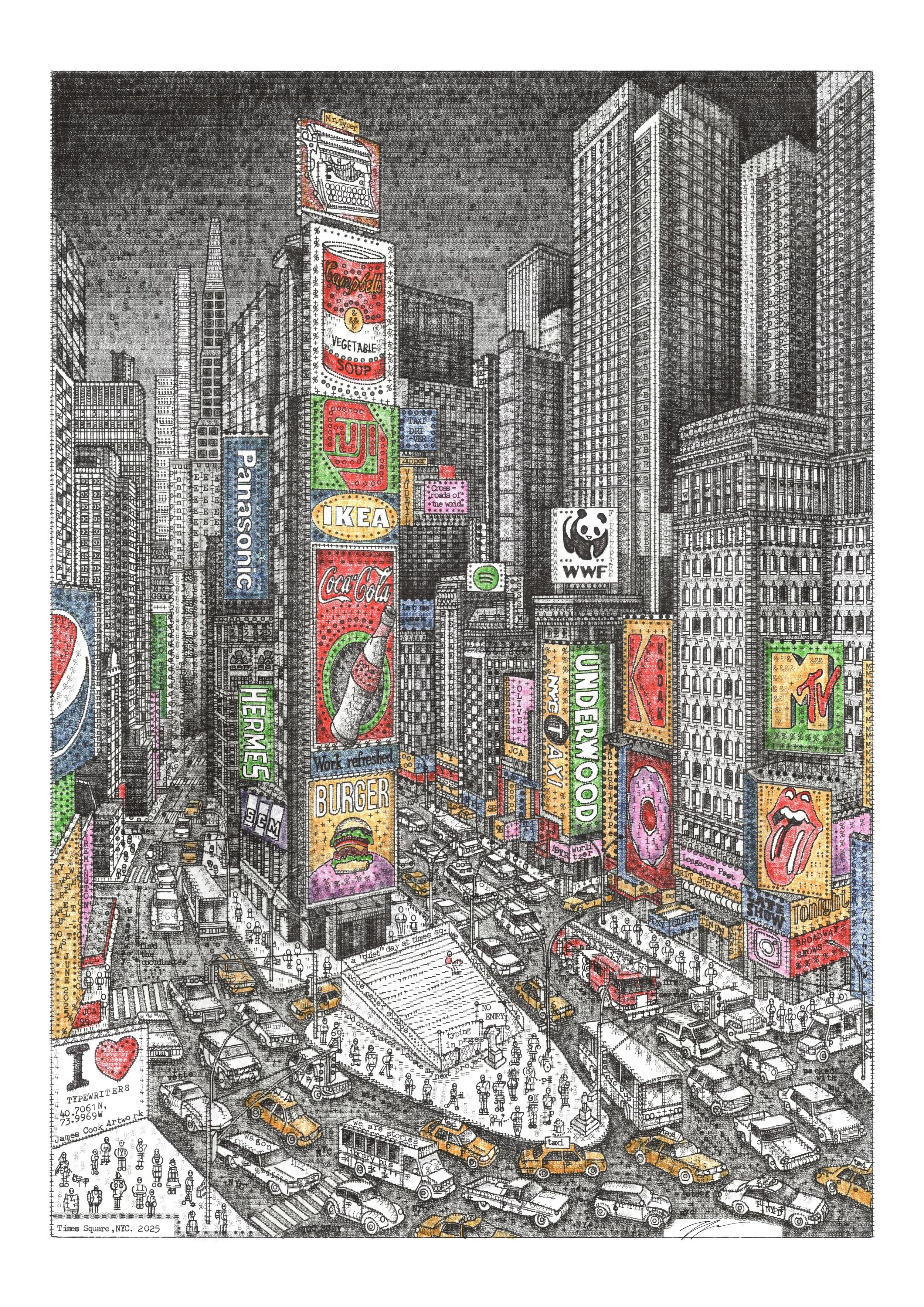
James and ‘Evening in Times Square NYC’
James Cook turns the mechanical language of the typewriter into intricate works of art. From London and Tokyo to New York and Wimbledon, he talks hidden messages, creative limitations and how a school project became an international practice.