
Four Beds, One Space To Dream.
The room has four beds. That tells you most of what you need to know, but not everything.
Four young women sleep here. Their clothes compete for space in a single wardrobe. Mattresses sit almost shoulder to shoulder. Washing hangs wherever washing can hang. A corner is for prayer, a corner for talking, somewhere to put the food, somewhere to put the shoes, and very little space left over for the idea of being alone.
Outside is Greater Cairo. Inside, four lives are being negotiated by the square metre.
Egyptian photographer Mirna Abass didn’t arrive here as an outsider with a camera looking for a story. In August 2025, while studying a course in Cairo, she was living in the dormitory herself.
The story was already around her. Eventually, she started photographing it.
FOUR BEDS, ONE SPACE TO DREAM.
Privacy is one of those things you don’t really think about until you don’t have any. A door you can close. A cupboard that’s yours. Ten minutes when nobody else is in the room. Somewhere to leave your shoes without somebody stepping over them.
In a university dormitory in Greater Cairo, those small luxuries are scarce. Four students live together, away from home, each with what Abass describes as a private space of no more than half a metre. Half a metre. Enough for a few belongings, a place on the mattress, maybe a bag. Maybe your thoughts, if you can keep those contained too.
And somehow, life continues.
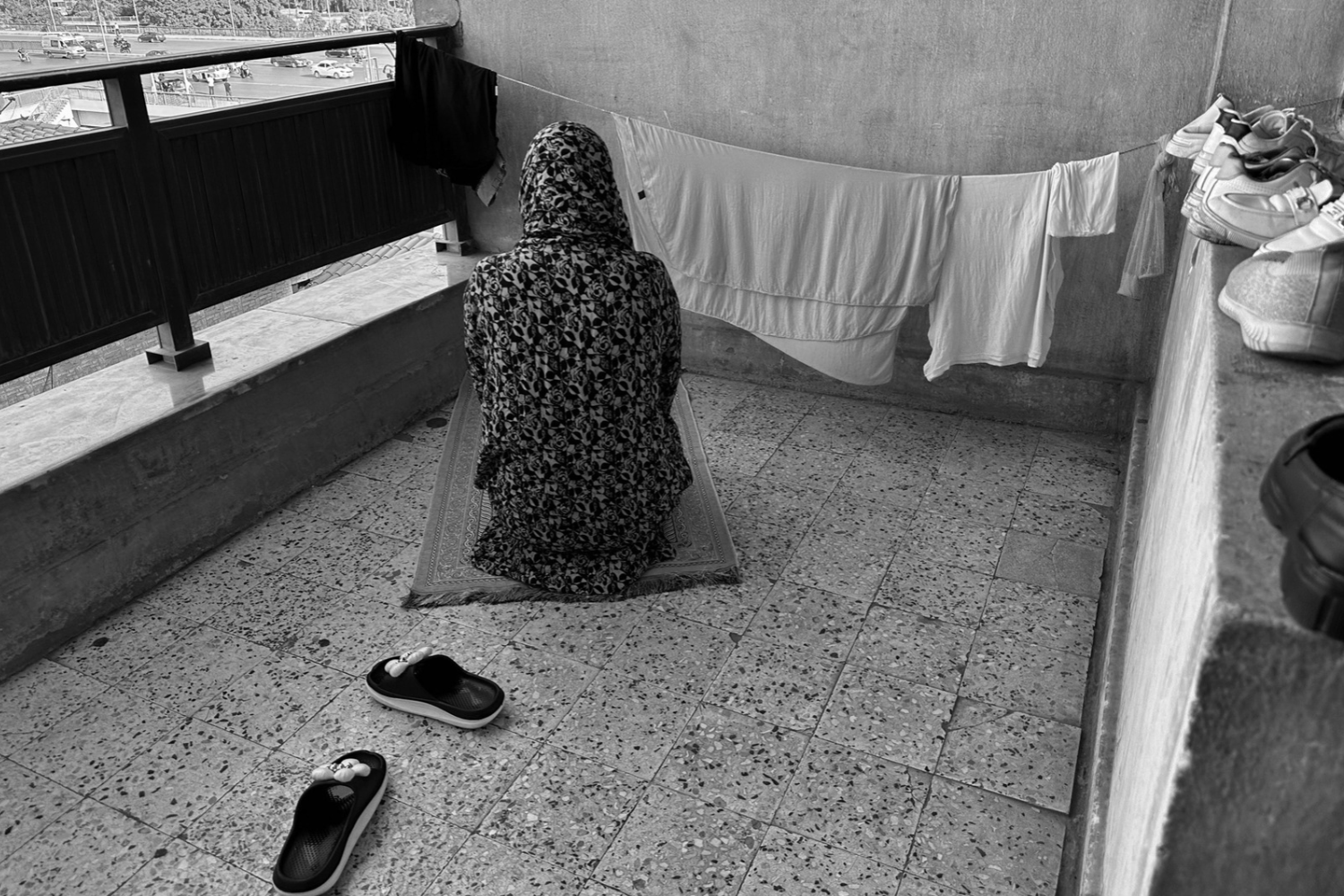
That is what makes Abass’s photographs interesting. They don’t scream about hardship. They don’t need to. Instead, they watch. A woman prays beside laundry drying in the Cairo air. Shoes line a ledge. Water bottles stand against a wall like an improvised inventory. Four mattresses are squeezed into a room. A wardrobe is packed with clothes, food and the miscellaneous evidence of four separate lives trying to fit inside one piece of furniture. Each woman pays approximately one US dollar for access to that shared wardrobe.
Nothing here has only one job. The bathroom is also the laundry. The balcony is also a place to pray. The bedroom is the dining room, living room, meeting place and somewhere to disappear when disappearing isn’t really possible. Even light becomes something to share.
Space isn’t simply occupied here. It’s negotiated.
A STORY FROM THE INSIDE.
Abass was born in 1998 and is based in Damietta, Egypt. She works in documentary photography and filmmaking, with a background in agricultural engineering. Her work has been recognised by Egypt Press Photo and the Farouk Hosny Foundation for Culture & Arts, and exhibited at the Egyptian Syndicate of Journalists and the University of Hyderabad in India.
But none of that particularly explains these photographs. Living there does.
Abass stayed in the dormitory while studying in Cairo, and the routines around her began turning into pictures. The sinks. The mattresses. The shoes. The wardrobe. The women gathered together. The strange choreography required when four people need the same tiny piece of space at roughly the same time.
One of her captions describes leaving the room in a hurry to grab her phone when she first realised she wanted to document what was happening around her. That’s probably the most important moment in the series. Not because anything dramatic happened. Because nothing did. This was simply life. And sometimes that’s when you realise you should start paying attention.
THE THINGS THAT BECOME HOME.
There’s an easy version of this story where everything is about overcrowding. Four women. Four beds. Shared bathrooms. Aging facilities. Humidity. No laundry. Very little privacy.
All true.
But look at the photographs long enough and something else begins to take over. Friendship. Conversations on beds. Food being shared. Music. Clothes drying. People waiting for bathrooms. Shoes removed before stepping inside. Someone praying while somebody else is probably doing something completely ordinary a few feet away.
This is what homes actually consist of. Not architecture. Repetition. The same person beside you in the morning. The same stupid joke. The same argument over space. The same shoes by the door. The same corner where everyone ends up sitting.
Abass describes one part of the room as, “Our favourite corner, where we share stories, dreams, and whatever food we have.”
Whatever food we have.
Not much space. Still enough to share.
HALF A METRE.
The black-and-white strips away another layer of distraction, and you start noticing geometry. Four sinks. Four beds. Rows of shoes. Rows of water bottles. Bodies squeezed against walls, windows and one another.
Architecture becomes part of the story because it controls the story. It decides where somebody sleeps, dresses, washes, stores possessions and prays. It determines where friendship happens and where, occasionally, somebody might manage to be alone.
The women remain anonymous. We don’t know their names, what they’re studying or exactly where they will end up. Instead, we know the evidence they leave around them. A suitcase. A blanket. A pair of shoes. A plastic bag of food. A mattress.
The temporary archaeology of being young and somewhere between the place you came from and the life you’re trying to reach.
THE COCKROACH.
And then there’s the cockroach. Tiny, almost ridiculous, sitting on a bed.
Abass describes it with the kind of humour that only comes from actually living somewhere: “Cockroach decided to take advantage of the fact that we had no presence on her bed and decided to take our place.”
It’s an important photograph because difficult living conditions aren’t experienced as one continuous dramatic event. Life doesn’t work like a documentary voiceover. Sometimes it’s uncomfortable. Sometimes it’s frustrating. Sometimes you find a cockroach on your bed, and the only reasonable response is to photograph it.
Then you get on with the day.
THE LAST PERSON OUT.
Abass was the last to leave. Before going, she made one final photograph.
The women are gone. The conversations are gone. The bags have been packed. What remains are beds, pillows, walls and the impression that something has just finished. A room that had been overcrowded suddenly looks enormous.
That’s the strange thing about spaces. Empty, they’re just architecture. People ruin them beautifully. They leave shoes against walls, bottles on floors, towels over sinks, food in cupboards, fingerprints on glass and mattresses pushed where mattresses were never supposed to go. They make noise. They take up too much room. They make somewhere theirs.
For a while, anyway.
Abass says photographing the experience made her realise “how a small shared space can hold so much of a person’s life, and how friendship and companionship can transform an unfamiliar place into something that feels like home.”
That’s really what Four Beds: One Space to Dream is about.
Not four beds. Not even the room. It’s about everything four people managed to fit between them.
And the lives waiting outside it.
ABOUT MIRNA ABASS.
Mirna Abass is an award-winning Egyptian documentary photographer, filmmaker, visual storyteller and agricultural engineer based in Damietta, Egypt. Her practice explores human stories through photography and film. Her work has received recognition from Egypt Press Photo and the Farouk Hosny Foundation for Culture & Arts and has been exhibited at the Egyptian Syndicate of Journalists and the University of Hyderabad in India.
Four Beds: One Space to Dream was photographed in Greater Cairo in August 2025 and has previously appeared through Social Documentary Network and WE ARE Magazine.
Photography: Mirna Abass | Instagram
Words and curation: Toni Veziris / BASE-CAST
Sky Shuyang Zhuang went looking for what American industry had left behind. Instead, he found communities living in limbo as the next industrial cycle approached.